The 61st Venice Biennale did not begin with art, but with weather. Lightning and thunder over the Giardini, torrential rain, overcrowded vaporetti, closed pavilions, inside-out umbrellas, drenched VIPs in rumpled linen. And in between all of that: Bengali fire from Pussy Riot in front of the Russian Pavilion, pro-Palestinian demonstrations, blue-and-yellow smoke clouds for Ukraine, security forces, protest chants, and then — moments later — blazing summer sun over the lagoon. One Spritz and the world looked different again. Between the Anthropocene and Disneyland. Venice at its best.
The city felt less like an exhibition than like an overheated operating system — permanently on the verge of crashing, completely overloaded, and somehow, inexplicably, still running. That might actually have been the truest thing about this Biennale.
Koyo Kouoh’s In Minor Keys — the first Biennale ever curated by an African woman — was overshadowed before it opened. Kouoh passed away in May 2025. What remained was a curatorial concept that didn’t rely on volume but on resonance. Not grand political slogans but the frequencies beneath them: ritual, memory, materiality, sound, fragility, body, survival. Minor key over major. Not a manifesto but a register, a sustained low note. Only the conductor was gone. And the orchestra played on. You could feel it everywhere. Because Venice was very far from listening quietly this year.
The Giardini felt like a geopolitical obstacle course between soft power and nervous breakdown. Embassy building after embassy building and weaving between them: the international art-world nomads — curators, advisors, artists, trustees, collectors, influencers, exhausted assistants, and a remarkable number of people who seemed to be primarily occupied with looking occupied.
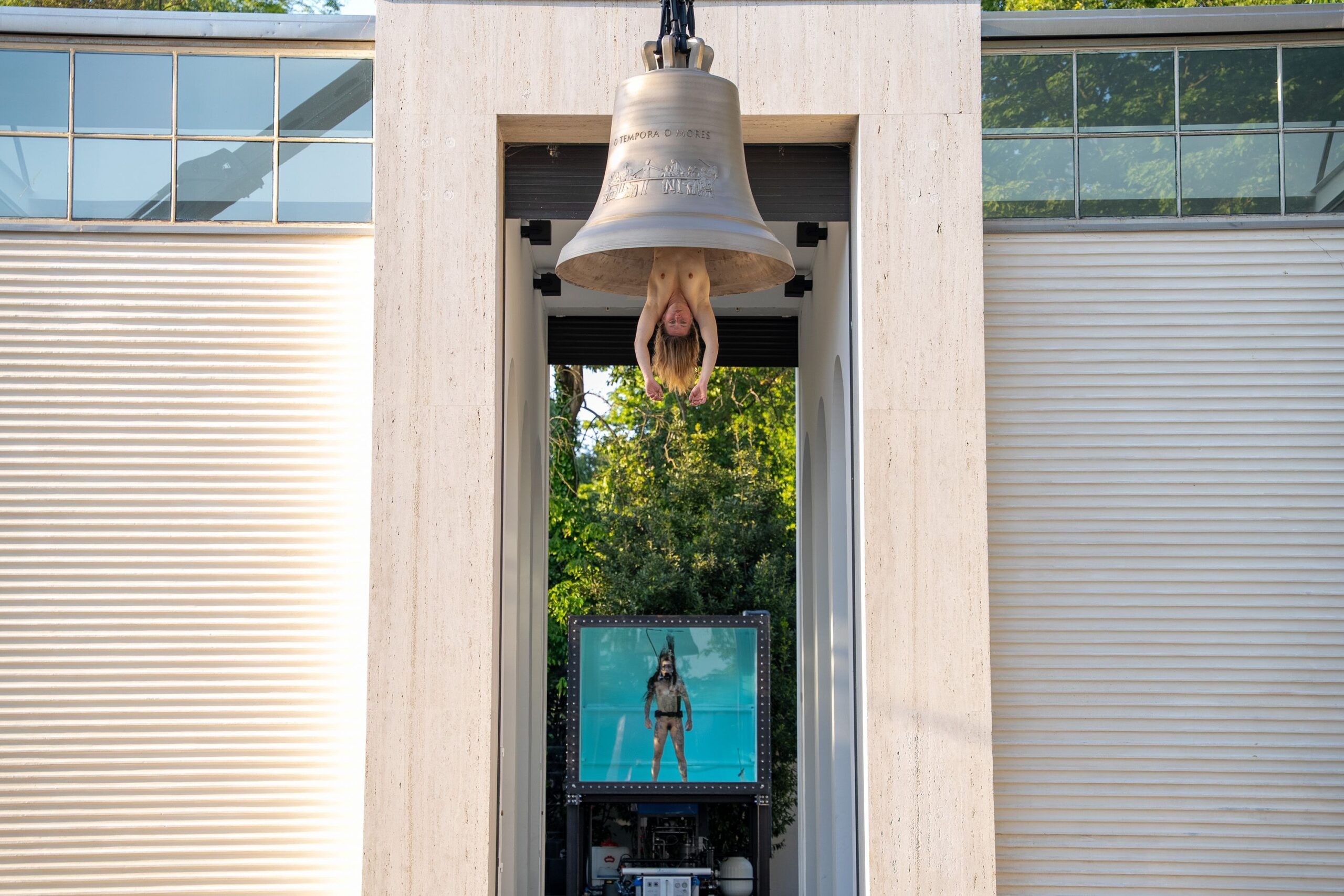
The Austrian Pavilion rang in the end times. Florentina Holzinger hung upside down inside a monumental bell, using her own body as the clapper, as if the Anthropocene were personally calling the faithful to Mass.
O tempora, o mores! Seaworld Venice became probably the most spectacular sewage treatment plant in art history: somewhere between waterpark, Viennese Actionism, and Hieronymus Bosch.
The pavilion swung between feminist catharsis machine, ecological end-times opera, and theme park of overwhelm: Apocalypse Now as immersive experience. But above all, Holzinger understood something very contemporary: that catastrophe is now consumed as spectacle. The Anthropocene has long since spawned its own entertainment industry. Nothing stayed clean, morally or infrastructurally.
Germany, by contrast, operated more quietly — with a particular German blend of precision, seriousness, and latent administrative trauma. Finally curated by an East German curator, finally with East German artists. What began as a dual position by Henrike Naumann and Sung Tieu was clouded by Naumann’s sudden death just weeks before the opening, and the pavilion became, involuntarily, a ruin: emotional, historical, biographical all at once. Sung Tieu, meanwhile, excavated a different German history — that of Vietnamese contract workers in the GDR, inscribed in bureaucracies, waiting structures, institutional cold. Small ladybirds appearing among administrative systems; her mother’s glass legs hanging from the walls like relics. Fragile body fragments against the hardness of state order. History here not as monument but as sediment. And beneath it, that strange German undertow: are we actually integrated by now, or do East and West still feel foreign to each other?
The American Pavilion was also symptomatic — probably not in the way intended. Alma Allen’s slow, organic sculptures seemed almost decoupled from the political fever outside. Resolutely apolitical. Carefully inoffensive. Almost aggressively decorative, though at least not gold-plated Mar-a-Lago baroque. Precisely because of that, it became readable: as the expression of an American exhaustion that would rather retreat into organic form than say anything out loud.
This Biennale was shaped by absences throughout. Russia remained geopolitically omnipresent — and in a move of breathtaking brazenness, drew the crowds with free alcohol, DJ sets, and event atmosphere. Opium for the masses with a side of art. Pussy Riot in the rain with Bengali fire outside. The Israel-Palestine war hung over everything like a second weather system: kufiyahs everywhere, gestures of solidarity, Gaza as permanent subtext — and on the other side, an almost equally loud institutional silence.
In the Arsenale, things finally started to breathe. Less pavilion politics. More atmosphere. Spiritual, even — Sufism, Candomblé, healing rituals, ancestral lines, cosmological systems. After the relentless geopolitical noise of the Giardini it felt like a shift from the news ticker to the unconscious. Kader Attia turned technology into a system haunted by ghosts; Alfredo Jaar cast rare earths and green promises in apocalyptic red; Tabita Rezaire wove indigo, spirituality, and healing into a material cosmology. And Cauleen Smith created with her Wanda Coleman cosmos one of the most quietly devastating emotional landscapes of the whole Biennale — somewhere between Los Angeles, mixtape, and memory.
The collateral exhibitions, scattered across the city, were the strongest in Venice. Perhaps because they were more focused. Less diplomatic. Less tired. At Prada, Nancy Spector brought together Arthur Jafa and Richard Prince. Two completely different image systems suspended between violence, media psychosis, and mythology. Michael Armitage showed some of the most powerful painterly positions in Venice at Palazzo Grassi: paintings between East African politics, myth, and European art history, made on lubugo bark cloth that inscribes memory materially. And at Canicula, Lawrence Abu Hamdan’s 450XL: The Story of a Fugitive Sound — a reconstruction of a sonic attack during protests in Belgrade — was perhaps the single most arresting work of the entire Biennale. Forensic. Invisible. Disturbingly precise.
What does this Biennale leave behind? Less a clear statement than a state of being. A cacophony of protest, climate anxiety, institutional exhaustion, body politics, spirituality, luxury industry, and collective overstimulation. A Biennale between minor key and alarm state. And yet, in all that noise, moments of astonishing precision kept appearing. Works that didn’t try to drown out the world but made its fine cracks audible. Perhaps that was Koyo Kouoh’s real gesture all along: not a choir, but an ensemble of contradictory voices. And a listening that can hold the dissonance.
Carolyn Stocker-Seiler and Marie-Kathrin Krimphoff