Prologue
Some summers are made for lounging by the sea. Others are for developing an intimate relationship with the Deutsche Bahn and convincing yourself that another exhibition is what your nervous system needs. After the Biennale in Venice, Gallery Weekends in Berlin, Munich and Zurich, Art Basel, and an overwhelming number of openings, one could reasonably assume the cultural calendar has exhausted itself.
While Europe breaks one temperature record after another, Spain, France and Greece burn, and tourists pilgrimage through the heaving streets of southern Europe, the most compelling detours might lie behind heavy wooden church doors. Within thick stone walls, centuries-old churches maintain temperatures that make even the most sophisticated air-conditioning systems seem rudimentary.
Forget the over-curated summer art itineraries. Some of Europe’s greatest masterpieces have been waiting in the same place all along. In Venice: Titian at Santa Maria Gloriosa dei Frari. Tintoretto at the Scuola Grande di San Rocco. Bellini at San Zaccaria. In Rome: Caravaggio at San Luigi dei Francesi. Michelangelo’s Pietà in St. Peter’s. Bernini’s Ecstasy of Saint Teresa in Santa Maria della Vittoria. No tickets. No timed entry. No VIP preview. No one reminding you that there’s a second seating. Just extraordinary art existing where it always has.
The more we talked about where to travel this summer, the more often we found ourselves ending up in churches. James Turrell opens his new Skyspace, The Dome, in Aarhus. In Ghent, Asad Raza turns the former Carmelite church of Kunsthal into a functioning tennis court. In Venice, Hans Ulrich Obrist dedicates the Vatican Pavilion to Hildegard von Bingen, transforming a monastery into a sound garden. And in Germany, where some 40,000 churches stand, with a growing share deconsecrated as congregations shrink, Manifesta 16 occupies twelve such buildings across the Ruhr region.
This Is Not a Church
Titled This Is Not a Church, the biennale spans twelve deconsecrated post-war churches in Duisburg, Essen, Bochum and Gelsenkirchen – 106 artists from 30 countries, free admission. It marks the final edition under Hedwig Fijen, who has shaped Europe’s wandering biennale since its founding in 1996 and steered it through cities including Palermo, Marseille, Prishtina and Barcelona. A new leadership duo takes over after this edition; institutionally, too, Manifesta stands at a threshold.
The Ruhr was never a classic metropolis. It was a web: mines, steelworks, motorways, workers’ estates, hospitals, schools, community centers, churches. A melting pot without a center, an urban archipelago. Visitors unfamiliar with the region struggle to tell Essen from Bochum from Duisburg; the districts run into one another even as the cities keep their separate names. Unlike a megacity radiating out from a dominant core, the Ruhr’s shape follows the lines of industry, the damage of war, the routes of labor, and the histories of the people who came to work here.
It is this dense, centerless urban fabric that the architect and urban planner Josep Bohigas spent a year mapping while developing the biennale’s Urban Vision: an inventory of existing social and spatial infrastructures, as well as those at risk of disappearing. The project builds on four years of research by curators, architects, urban planners, and residents in a region that has repeatedly had to reinvent itself.
The Ruhr has always been shaped less by origins than by movement and necessity. Forced laborers were central to the Nazi war economy, while later generations of so-called Gastarbeiter became essential to West Germany’s post-war reconstruction. The region’s diversity emerged from economic conditions, with communities formed through neighborhoods, factory shifts, football clubs, and churches.
Forty-three percent of North Rhine-Westphalia’s churches were built after the Second World War: modern, often experimental, and deliberately conceived less as monuments than as places to gather. When the Diocese of Essen was founded in 1958, it followed the idea of the Pantoffelkirche — literally, the “house-slipper church.” Every parish should be close enough to reach on foot.
Manifesta 16 Ruhr
Maybe the true radicalism of Manifesta 16 lies in the fact that it doesn’t build anything anew. It simply opens doors. A response to social distancing, the privatization of public space, the alienation of younger generations, and the lingering aftereffects of the pandemic, it seeks to redefine the conditions of collective life. These twelve churches are not simply vessels in which art appears but rather renewed sites of collective togetherness.
When the Ruhr region applied to host Manifesta in 2021, it described itself as a new Silk Road: a web of origins, movements, visions. At the time, this largely read as the language of a bid, yet four years later, the framing appears more grounded. The region has positioned itself around the ambition of becoming the world’s greenest industrial region. The increasing presence of artists relocating from Berlin to the Ruhr, together with an international biennale focusing on neighborhoods rather than established cultural institutions, points to a broader cultural shift. It suggests a gradual revaluation of the region that coincides with efforts to counter its recent rightward political trajectory. As living costs continue to rise in Berlin while remaining comparatively low in the Ruhr, the region has also become a more viable location for artistic production.
The twelve churches were entrusted to intergenerational pairs called Creative Mediators, shifting the role of curator away from selection and authorization and toward mediation, between building and neighborhood, history and present, international position and local knowledge.
René Block, the former director of the Fridericianum and a longstanding figure in Fluxus, is paired with the young curator Leonie Herweg. The museum director Anda Rottenberg collaborates with the critic Krzysztof Kościuczuk. Henry Meyric Hughes, former director of the Hayward Gallery, works with the writer and curator Michael Kurz. The urbanist Josep Bohigas, who contributed to the region’s Urban Vision, is responsible for one church. Gürsoy Doğtaş, meanwhile, centers the Ruhr’s migrant history, particularly its German-Turkish communities.
Taken together, these positions approach the churches from different disciplinary and cultural perspectives while addressing the question: what becomes of a church once its liturgical function is gone?
Gelsenkirchen. Gürsoy Doğtaş approaches the question through migration rather than chronology, structuring three churches around three re-namings: living room, music hall, and tea garden.
In the Thomaskirche, whose crystalline structure will become an architecture office after the biennale, textile works by first-generation female Turkish artists are presented. Often dismissed as domestic craft, these works instead emerge as repositories of memory, labor, and cultural transmission. Their presence also recalls the church’s own history of textile production, where women embroidered liturgical vestments.
At St. Anna, hip-hop fills a dance floor constructed over the altar. In a side chapel, Cana Bilir-Meier’s film presents a choir of former labor migrants singing selections from the more than 30,000 entries submitted to a 1970 West German competition intended to replace the term Gastarbeiter. Suggestions such as “foreign brother,” “diligent ant,” “partial citizen,” and “homeless one” are set to the melody of a children’s song, shifting bureaucratic language into collective performance.
St. Bonifatius is organized as a tea garden, where herbs and dried plants evoke forms of belonging that developed through everyday practices rather than state integration policies. Across all three churches, a permeable lattice structure serves as the exhibition architecture, supporting the works while connecting the different sites. Part scaffold and part screen, it reflects the negotiation of languages, places, and forms of belonging that runs through the exhibition.
Doğtaş brings together artists including Nil Yalter, Azade Köker, Judith Raum, and Cana Bilir-Meier, situating migrant histories as one of the Ruhr’s constitutive narratives.
Essen. René Block and Leonie Herweg take a more conventional curatorial approach, foregrounding the exhibition rather than the participatory framework while pursuing a related question: what becomes of practices of devotion once religious ritual recedes?
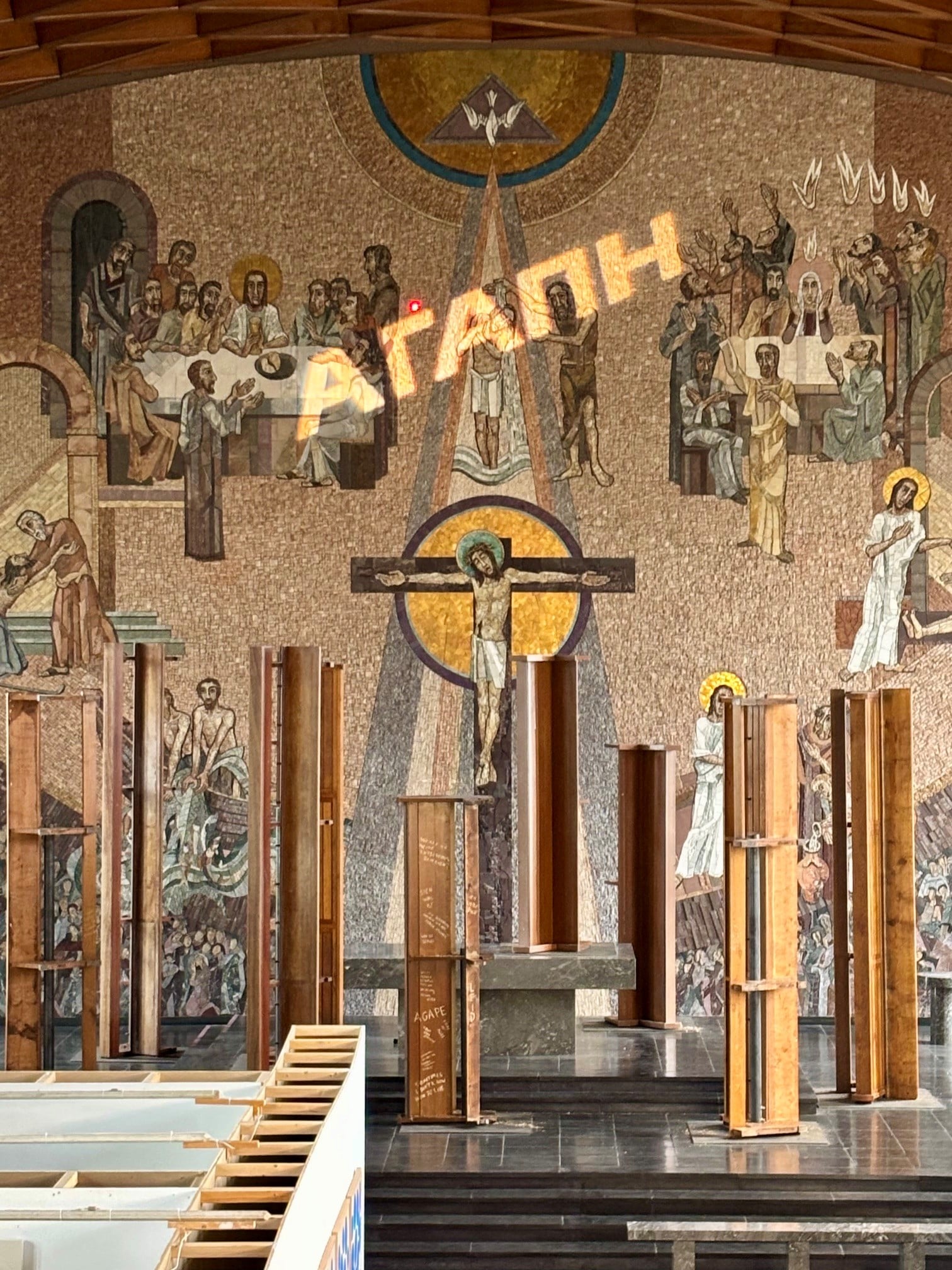
At St. Gertrud, whose “broken style” reflects its simplified post-war reconstruction, Ayşe Erkmen’s AI confessional is presented alongside Nasan Tur’s Elevation. The confessional translates the ritual of absolution into a technological interface, offering algorithmically generated responses without penitential practice. Tur’s installation, meanwhile, accumulates wishes and concerns submitted by visitors throughout the biennale and carved into former church pews. Rather than disappearing, gestures of hope and confession are redirected into secular forms of expression.
Above the installation, the Greek word Agape, retained from the church’s original mosaic inscription, reframes these gestures less as religious acts than as forms of social connection. In the nave, students from HBK Essen work within temporary drywall structures, allowing art school, church, and biennale to coexist within the same space.
St. Marien, an austere brick church whose verticality recalls the region’s mining architecture, is scheduled for demolition after the biennale. Jason Dodge covers the floor with an assemblage of plastic, lavender, hay, pigments, seeds, and other discarded materials, transforming the nave into a walkable landscape. Katharina Fritsch’s monumental pink birch cross stands alongside William Engelen and Dagmara Genda’s installation of 144 suspended metal pipes, which visitors activate with mallets, recalling the collective experience of an organ without reproducing the instrument itself. Annika Kahrs extends this exploration in a film documenting musicians and carpenters working together in a deconsecrated church in Lyon. Across these works, sound and ritual persist, reconfiguring the social functions of the sacred space rather than leaving it abandoned.
Duisburg. Michael Kurz and Henry Meyric Hughes approach the Kulturkirche Liebfrauen with a notably restrained exhibition, examining the disappearance and transformation of religious forms.
Elizabeth Price continues her long-running engagement with post-war church architecture by placing a church in Bermondsey, London, in dialogue with Essen’s Marienkirche, rebuilt on the ruins of its predecessor. As Price has described it, post-war church architecture becomes an “expression of post-war trauma,” connecting reconstruction to the social and psychological aftermath of war.
Nearby, Abbas Zahedi presents an installation of organ pipes salvaged from decommissioned and damaged churches across Europe, including one from a church in Kyiv. Stacked into a dense sculptural arrangement, the pipes no longer produce sound but register the absence of the communal rituals they once supported. Shown alongside Price’s work, the installation links the historical reconstruction of post-war Europe with the continuing impact of contemporary conflict, suggesting that the material remains of churches continue to carry social and political histories even after their liturgical function has ended.
Bochum. Anda Rottenberg and Krzysztof Kościuczuk shift the emphasis from memory itself to the politics of remembrance: not only what, but whose histories are preserved.
At Christ-König, Mirosław Bałka’s Madonna connects Marian iconography with the material history of the Ruhr’s mining economy. Standing three meters tall and cast from coal, the seated, hollow-eyed figure is empty-armed, the child in her lap long gone, a mother Bałka describes as tired, childless, and as much a question about the motherland as the fatherland. Nearby, Luc Tuymans’ 36-meter painted curtain, KINO, reproduces stills from Leni Riefenstahl’s Triumph of the Will, replacing the Nazi flags with blue monochromes and removing the swastikas. The work neither restores nor erases the historical imagery, examining how its visual language continues to circulate after its ideological symbols have been removed. In the sacristy, which is traditionally inaccessible to the congregation, Aline Bouvy replaces wooden cabinet doors with colored Plexiglas, exposing liturgical objects that had remained concealed within the architecture itself.
The exhibition’s most sustained engagement with the Ruhr’s social history is found at St. Anna, where Pınar Öğrenci’s film Glück auf! in Deutschland draws on the photographic archive of the Ruhr Museum to reconstruct the largely overlooked histories of Muslim and migrant miners whose labor underpinned West Germany’s post-war economic growth. While central to the region’s industrial development, these communities remain underrepresented in institutional archives and public memory. One archival photograph shows miners and their families dressed in white during a public demonstration, consciously performing respectability and belonging. Viewed against more recent anti-migrant political gestures in the region, the image points to the persistence of exclusion despite changing historical circumstances. The closure of the mines further complicates this history, as the disappearance of industrial labor also dismantled long-standing forms of social identity and community. The post-war Pantoffelkirchen, dispersed throughout new housing estates, likewise reflected not only pastoral ambitions but also wartime planning strategies that favored decentralized settlement patterns.
Outside the nearby Gethsemanekirche, Marina Naprushkina installs an inflatable church bell bearing the slogan “We never go back” in a typeface that deliberately recalls the visual language of National Socialism. Visitors activate the work by jumping inside it, becoming the bell’s clapper without ever producing a sound. The installation links contemporary debates around migration with the histories of forced labor and labor migration that continue to shape the Ruhr.
Inside the church, Bałka presents the word Heimat, rendered in six languages and mirrored so that it remains difficult to read, treating belonging as something that resists fixed definition.
The exhibition concludes with a church that contains almost no artwork in the conventional sense. Josep Bohigas transforms a geometric post-war church into a space for play and collective use. The Catalan collective Cabosanroque installs three oversized basketball hoops connected to gymnasium bars, with hidden string instruments and organ mechanisms activated by missed shots (pictured). Rather than functioning as a sculpture to be observed, the installation depends on participation.
During the exhibition, neighborhood children, visitors, curators, collectors, and former clergy occupy the space simultaneously, translating it into a shared civic center, where recreation, cultural production, and everyday social life temporarily coexist.
Epilogue
What Manifesta 16 proposes in the Ruhr extends beyond the format of a biennale. The project asks whether the functions historically bound up with churches: assembly, exchange, care, education, ritual, can be reactivated through other forms of public use.
These buildings are also valuable urban assets: located at the center of residential neighborhoods, many facing uncertain futures. By occupying them temporarily, the biennale makes the case that they can support collective life beyond both worship and commercial redevelopment. The real question, then, isn’t what happens to redundant churches, but who assumes the civic role they once fulfilled (a question that outlasts the Ruhr, as secularization continues across Europe). Churches remain one of the continent’s most extensive public building networks; their significance may now lie less in religious practice than in their capacity to hold community.
Perhaps that’s why art and church keep encountering each other: neither was ever merely a place; both were social institutions. Language gives this away: the French la messe still means Mass, from the Latin missa — “Ite, missa est“: go forth, you are sent. Around the same time, a second word grew out of church holidays: foire, fair, from the Latin feriae. On the days people prayed, they also traded. Church squares became markets, markets became fairgrounds, fairgrounds became art fairs. The art fair is no invention of modernity — just the latest form of a very old idea, with better catering.
We still make our pilgrimages: to Basel, London, Paris, Miami, meeting the same people, trading the same stories. My grandmother, now 98, once told me she had to sit through three Masses in a row every Sunday as a child — not out of piety, but because it was the only chance to see everyone in the village. The church was marketplace, news exchange and concert hall in one. Our paths may differ less from our grandparents’ than we like to think. The art world has globalized community; Manifesta is a reminder that every community still begins somewhere concrete, often behind a heavy church door.
On October 5th, Manifesta moves on and the art world heads to its next stop. The churches stay behind — standing in their neighborhoods, empty, uncertain, up for grabs. It would be careless to let this experiment have no consequence, especially now, when social divides are growing more visible. These twelve churches have shown that community needs space, somewhere people can meet, play, argue, or simply be beside one another. That’s the real achievement of Manifesta: not a new building, but the visibility it gave to an overlooked infrastructure of community.
Churches have survived wars, industrialization and secularization. They may be Europe’s most enduring infrastructure, still standing where life has crossed paths for centuries. The real question isn’t what should become of them. It’s whether we’re ready to use them again.
Marie-Kathrin Krimphoff & Carolyn Stocker-Seiler