Dr. Jörn Quitzau und Steffen Killmaier, 05 August 2026
- U.S. dollar under pressure. While the world is undergoing economic and political realignment, shifts in the currency markets have so far been moderate. Although the U.S. dollar came under significant pressure last year, it managed to stabilize and has even staged a moderate rebound this year.
- Still in demand as a safe haven. The war in Iran shows that the U.S. currency has not yet lost its role as a safe haven, despite all the uncertainties surrounding U.S. politics. Immediately after the war began, the U.S. dollar posted gains on the foreign exchange market.
- Status as a reserve currency not threatened for the time being. As a reserve currency, the U.S. dollar remains the clear number one, far ahead of the euro. This is unlikely to change much in the short and medium term. Over decades, the U.S. has attained outstanding political, economic, and financial significance. The U.S. dollar is at the center of the global financial system and is virtually irreplaceable in the short and medium term.
- New Fed chair seen as a positive sign. Following the U.S. president’s massive attacks on the Federal Reserve, the appointment of Kevin Warsh as the new chair of the U.S. central bank had a stabilizing effect on the dollar. Warsh is regarded as a serious, old-school monetary policymaker for whom monetary stability is of paramount importance. At his first press conference in June, Kevin Warsh came across as determined, dynamic, innovative, and knowledgeable. He emphasized repeatedly that the Federal Reserve would ensure price stability—which initially impressed the markets.
- Words are no substitute for action. Warsh’s purely verbal announcement that he would bring inflation under control no longer resonated as strongly at his second press conference as it had the month before. Despite all its assurances, the Fed is likely to display a certain tolerance for inflation even under Kevin Warsh.
- The euro is failing to seize the moment. The monetary union suffers from structural problems. Growth potential is weak, the euro’s design flaws persist, Europe’s political clout is limited, and Europe is not self-sufficient in defense and energy supply. Despite these structural disadvantages, the euro could appreciate slightly against the U.S. dollar if geopolitical tensions ease somewhat.
The world is in a state of upheaval. The financial markets are reassessing the (uncertain) future. One of the key questions is: What will happen to the United States’ global leadership role? Can the U.S. remain the world’s No. 1 power, both politically and economically?
U.S: Dollar Under Pressure
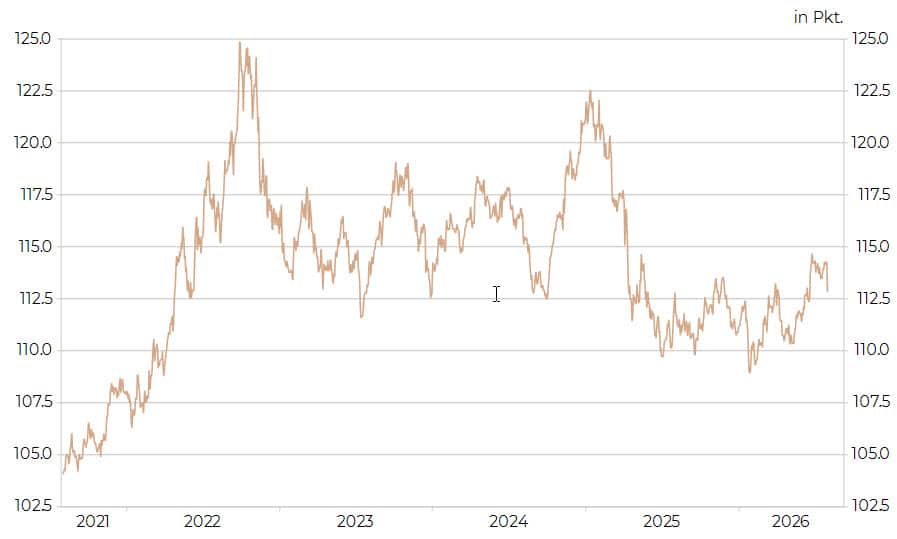
The possible answers to this question are also driving the foreign exchange market. Nevertheless, the answers so far are by no means clear-cut. Following U.S. President Donald Trump’s inauguration, the U.S.: dollar came under massive pressure. In the first half of the year, the trade-weighted dollar exchange rate lost value dramatically (Fig. 1). Trump’s disruptive and erratic behavior, his misguided trade policies, the pressure on the Federal Reserve, and his disregard for (international) institutions eroded a great deal of confidence not only among the public but also among investors.
Fig. 1: Trade-weighted U.S. dollar
Source: Macrobond
The U.S. president stopped at practically nothing. On the international stage, his ambiguous stance on the Russia-Ukraine war caused concern. The dispute with Ukrainian President Zelenskyy at the White House, which played out before the eyes of the global public, made this very clear. As things progressed, Donald Trump caused further upheaval by repeatedly distancing himself from NATO and even threatening to annex Greenland.
For the international financial markets, the political pressure on the central bank was of paramount importance. Donald Trump not only exerted pressure on the Fed as an institution but also attacked individual members of the Federal Reserve Board. For example, he announced – on flimsy grounds – the dismissal of Fed Governor Lisa Cook. Cook did not accept the U.S. president’s announcement, remained in office, and successfully sued to overturn her dismissal. Jerome Powell, who served as Fed chair until May 2026, was initially mocked by Donald Trump for months. In early 2026, the pressure on Powell intensified once again. Trump accused the Fed Chair of being responsible for the spiraling and unplanned costs of the renovation work at the Fed’s headquarters in Washington, D.C. This was followed by a criminal investigation into Jerome Powell, which was, however, (temporarily) suspended in April. Even though Trump ultimately failed in both cases, the impression remains that the Fed’s leadership must carry out its work under considerable political pressure.
In addition, in August 2025, Donald Trump took advantage of Governor Adriana Kugler’s resignation to fill the vacant position with his confidant and economic policy advisor, Stephen Miran. Miran advocates an unorthodox economic policy. Miran’s trade policy ideas read like a blueprint for Donald Trump’s tariff policy. Furthermore, Miran sympathized with the idea of the so-called Mar-a-Lago Accord, under which other countries would be forced to purchase U.S. government securities at low interest rates. As expected, during his tenure (September 2025 to May 2026), Miran voted for a more accommodative monetary policy than the other voting members of the Federal Open Market Committee at every Fed monetary policy meeting.
A Boost for the Euro
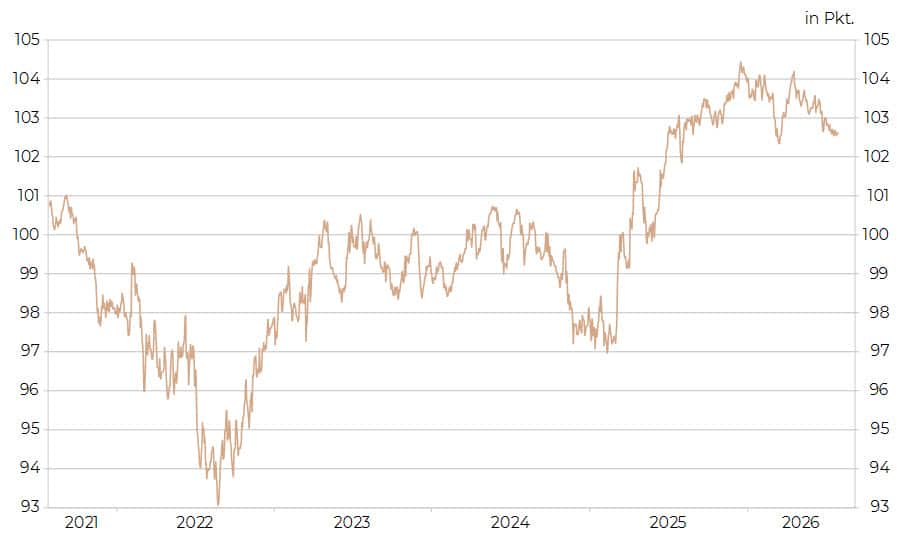
As the world grew increasingly frustrated with the Trump administration’s policies and international investors began looking for alternatives to the United States and the U.S. dollar, Europe and the euro regained momentum. The European single currency strengthened not only against the U.S. dollar but across the board (Fig. 2).
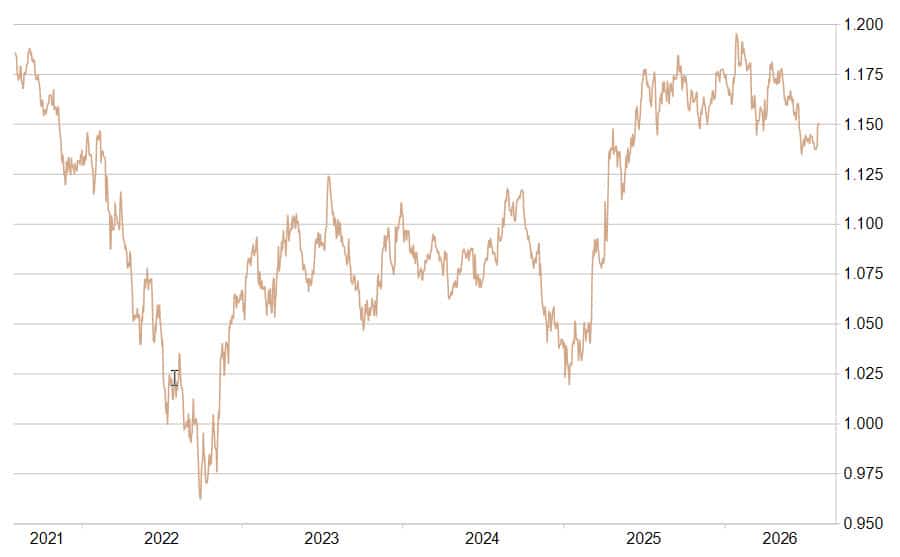
While Donald Trump gradually undermined the U.S.’s reputation and international role – which had been built up over decades – Europe, with its rule of law and comparatively high level of reliability, suddenly appeared to be the natural alternative to the U.S. The bilateral exchange rate rose from around 1.02 U.S. dollars per euro at the beginning of 2025 to 1.18 U.S. dollars per euro in September 2025. Measured in terms of trade-weighted exchange rates, the rise of the euro was about one-third due to the strength of the euro and two-thirds due to the weakness of the dollar.
U.S. Dollar: Still Alive
Anyone who thought this would lead to a full-blown collapse of the dollar was proven wrong. Despite all the dire reports coming out of the U.S., the EUR/USD exchange rate briefly dipped toward the 1.20 mark, but then the U.S. dollar stabilized, and over the course of 2026, a counter-movement took place, bringing the rate down to 1.13 U.S. dollars per euro.
When the war with Iran broke out, it became clear that the U.S. dollar is still sought after as a safe haven in times of crisis. Despite all its political antics, the U.S. still enjoys many structural advantages. As the world’s largest oil producer, the U.S. weathered the oil price shock better than European countries. Furthermore, the country is generally considered energy-independent. Many of the most promising companies, including the major technology conglomerates, are headquartered in the U.S. The economy is proving resilient, and growth potential remains at around 2 percent – as if U.S. President Donald Trump’s misguided (tariff) policies did not exist. The political and military power of the U.S. remains very strong, allowing the United States to continue setting the rules of the game in many areas. The U.S. dollar remains indispensable as a reserve currency. Due to a lack of alternatives, a shift away from the U.S. currency is possible only gradually and, in the short term, only within narrow limits.
Fig. 2: Trade-Weighted Euro
Source: Macrobond
The appointment of Kevin Warsh as chairman of the U.S. Federal Reserve also played an important role in the foreign exchange market. The concern among many market participants that Jerome Powell’s successor might merely be a puppet of the U.S. president and pursue an accommodative monetary policy regardless of macroeconomic data was put to rest with Kevin Warsh’s appointment. Warsh is regarded as a serious, old-school monetary policymaker for whom monetary stability is of central importance. However, he is also said to possess sufficient flexibility and pragmatism, which should make dealing with President Donald Trump easier.
Right from his first press conference in June, Kevin Warsh came across as determined, dynamic, innovative, knowledgeable, and very eloquent. He emphasized repeatedly that the Federal Reserve would deliver price stability (in line with its 2 percent target) – even though inflation has consistently exceeded the Fed’s 2 percent target every month since March 2021. Warsh also announced the formation of five working groups to conduct a thorough review of the Fed’s monetary policy.
Fig. 3: EUR/USD Exchange Rate
Source: Macrobond
The financial markets were impressed. Even though the Fed had not raised the key interest rate, the U.S. dollar rose by about two and a half cents against the euro in the days following the June interest rate decision. The financial markets once again priced out the previously feared politicization of the Fed. Now, expectations of a tighter monetary policy were gaining traction.
At the press conference following the central bank’s July meeting, Kevin Warsh came across as just as resolute and eloquent as he had in June. Once again, he stated that the Fed would ensure price stability. And once again, the Fed kept the benchmark interest rate unchanged, even though the inflation rate remained significantly too high. This suggests a certain tolerance for inflation even under Kevin Warsh, who personally – unlike three other members of the Federal Open Market Committee (FOMC) – voted to maintain the current benchmark interest rate rather than raise it.
The foreign exchange market reacted differently than it had in June. Following the press conference, the U.S. dollar came under pressure against the euro (though positive economic data from the eurozone also bolstered the euro). Even during the press conference, journalists asked critical questions. They wanted to know what measures the Fed intended to take to lower inflation rates. The purely verbal announcement that inflation would be brought under control no longer resonated at Kevin Warsh’s second press conference as it had the previous month. The view seems to be gaining ground that words can only go so far in replacing action. Good intentions are not enough, even when they are eloquently expressed.
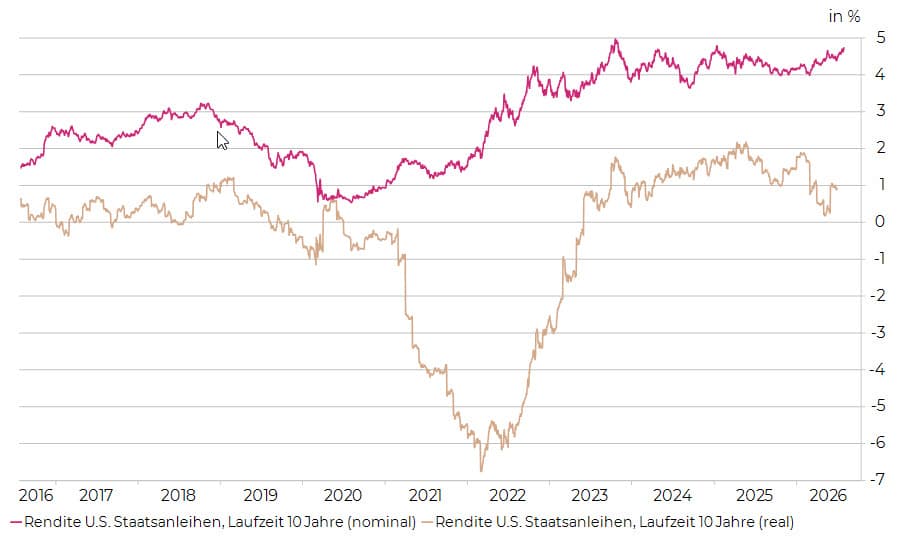
The U.S. Federal Reserve has a dual mandate. It is tasked with ensuring price stability and maximum employment. However, a stable financial market is a key prerequisite for this. Given the immense U.S. national debt and the fact that interest rates have now risen again, the U.S. Treasury Secretary must allocate an ever-larger portion of the budget to interest payments. If the government were to run into financing difficulties and interest rates on U.S. Treasury bonds were to rise abruptly, the Federal Reserve’s ability to fulfill its dual mandate would be jeopardized. That is why the Fed must also keep a close eye on the development of market interest rates. This is where the mitigating effect of inflation comes into play. While the nominal yields on 10-year U.S. Treasury bonds currently stand at just over 4.7 percent, inflation significantly reduces real yields to just under one percent at present (Fig. 4). Slightly higher inflation thus has positive side effects not only for the U.S. Treasury Secretary – because it boosts tax revenues – but also for the central bank, because it somewhat alleviates the U.S. government’s financing pressures, at least in the short term.
Fig. 4: Nominal vs. Real Interest Rates (10-Year U.S. Treasury Bonds)
Source: Macrobond
It is still too early to judge the Fed’s future course under Kevin Warsh. The findings and recommendations of the five working groups, which are expected to be released by the end of the year, should prove particularly interesting. Surprises that could significantly alter current monetary policy practices cannot be ruled out.
The Euro as an Alternative?
The euro experienced a false boom last year with its exchange rate gains. For a time, the foreign exchange market ignored certain factors that structurally weigh on the euro and the eurozone economy. At around one percent, the eurozone’s growth potential is only about half that of the U.S. Germany, in particular – the eurozone’s largest economy – is barely making headway with a growth potential of 0.3 percent. The economic policy reforms presented by the German government in early July should at least help maintain this meager growth potential for the next few years. Without reforms, economic research institutes estimate that growth potential would fall to zero percent by the end of the decade.
It also remains true that European countries are far more dependent on energy imports than the United States. Furthermore, Europe is geographically close to the war zone and to Russia, and without U.S. support, its ability to defend itself is limited. Overall, Europe also suffers from a lack of political clout on the international stage. All these shortcomings cannot be remedied overnight.
Beyond security risks and sluggish growth, the euro also continues to suffer from its structural flaws. The eurozone is not an optimal currency area for several reasons. Monetary policy in the eurozone is unified, or centralized. Fiscal policy, on the other hand, remains decentralized and is determined by the nation-states. Aware of these structural weaknesses, the architects of the monetary union initially required participating countries to implement a convergence program before the union’s launch in order to level out macroeconomic differences. In addition, they established a set of monetary and fiscal policy rules for the eurozone to nip potential problems arising from differences among member states in the bud.
Three key elements were intended to protect the monetary union from inflation and debt crises:
1. The European Stability and Growth Pact: A country’s budget was to be balanced over the course of an economic cycle. During economic downturns, deficits of up to 3 percent of gross domestic product (GDP) were permitted, and the debt-to-GDP ratio was to not exceed 60 percent of GDP.
2. The so-called no-bailout-rule (Art. 125 TFEU) stipulates that neither the European Union nor any individual member state may be liable for or guarantee the debts and obligations of another state. This was intended to align action with liability – each eurozone country was to be held accountable for any fiscal missteps and could not rely on outside assistance.
3. The independence of the European Central Bank (ECB) is intended to ensure that monetary authorities can focus solely on maintaining price stability and cannot be pressured by highly indebted governments to loosen monetary policy inappropriately.
All three elements are more than fragile. The fiscal rules of the Stability and Growth Pact were never taken particularly seriously by governments; otherwise, the euro debt crisis that began in 2010 would not have occurred. The original fiscal rules, as well as those added later, were treated by eurozone member states more as recommendations than as binding requirements. According to the EU Compliance Tracker, France complied with the rules in only about a quarter of cases between 1998 and 2025. In other words, France has mostly violated the rules of the monetary union. Today, with a debt level of 115 percent of GDP – almost twice the maximum allowed under the Stability and Growth Pact – France stands on the brink of a debt crisis. Greece, which triggered the debt crisis beginning in 2010, complied with the rules in about 40 percent of cases between 1998 and 2025. And even Germany, which is considered fiscally sound, complied with the rules only in 54 percent of all cases. Incidentally, there have been no real penalties for rule violations to date, which severely undermines the credibility of the rules.
Fig. 5: Low compliance with fiscal rules
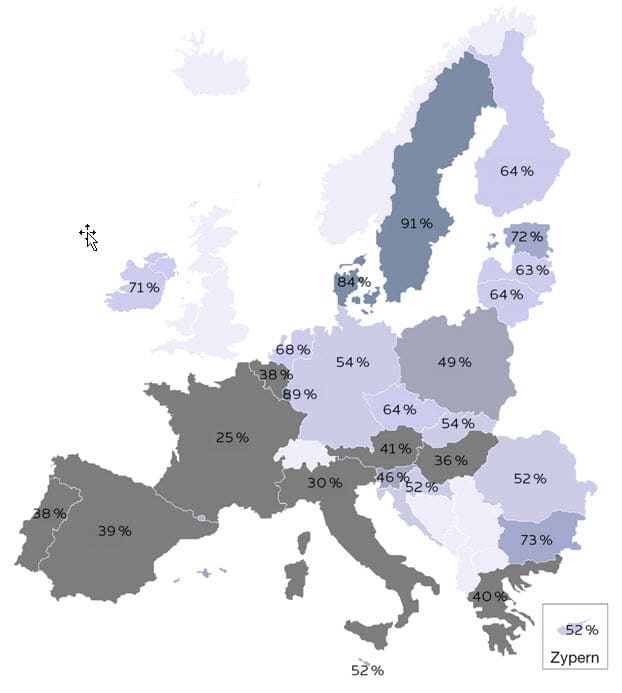
Source: Europäischer Fiskalausschuss, eigene Darstellung. Durchschnittliche Einhaltungsquote der Fiskalregeln von 1998 bis 2025. Compliance Tracker
Greece found itself in a self-inflicted debt crisis due to its failure to comply with fiscal rules. In this situation, the European community of nations decided to circumvent the second pillar of the monetary union – the no- bailout-rule – by coming to Greece’s aid and not leaving this assistance and economic adjustment programs solely to the International Monetary Fund.
Since the financial markets questioned whether EU countries had sufficient financial resources to adequately support Greece and, if necessary, other highly indebted nations, the debt and confidence crisis continued. Ultimately, the ECB was forced to intervene and pledge potential support for struggling eurozone member states, in principle without limit. This did not require a directive from government representatives, but merely the serious risk that the monetary union could break apart under the burden of excessive government debt. Although the ECB was still politically independent, it was no longer independent in its actions from the market risks that had arisen due to the fiscal missteps of some eurozone member states (“fiscal dominance”).
Following the European sovereign debt crisis, the monetary and fiscal policy framework was overhauled as part of the “cleanup” efforts. However, public debt remains too high. On average, the member countries of the monetary union are in debt to the tune of more than 85 percent of GDP. The eurozone as a whole is thus significantly more indebted than the 60 percent of GDP permitted by the debt criterion. Some large economies such as France (115 percent) and Italy (137 percent) are in debt at above-average levels, meaning that the risk of a new sovereign debt crisis lies latent within the monetary union.
Fig. 6: Creditor structure of eurozone sovereign debt
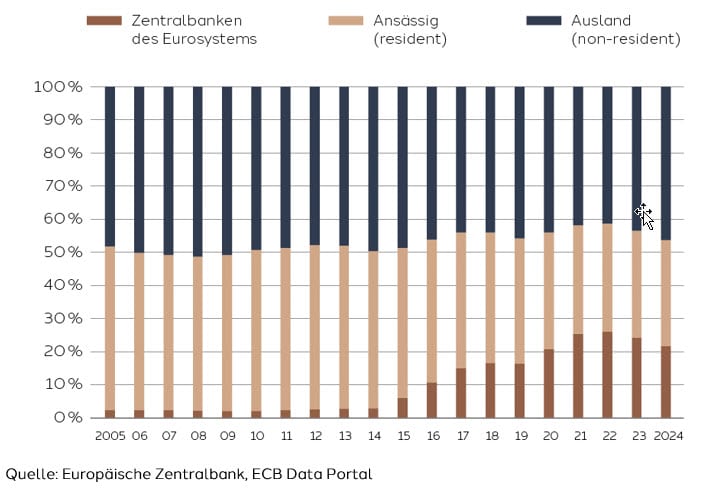
Source: ECB Data Portal
The ECB plays an important role – one not originally intended for it – in the monetary union’s new fiscal architecture. Since 2015, it has lowered interest rates – and thus the financing costs for governments – through massive purchases of government bonds. Should France or Italy ever lose the confidence of the financial markets, the situation would likely be unmanageable without the ECB’s assistance. The ECB thus retains its role as a lender of last resort in times of crisis.
The problems outlined above have meant that the euro has so far been unable to seriously challenge the U.S. dollar’s role as the world’s reserve currency. Although the euro is now an established currency, it still lags significantly behind the U.S. dollar. In the first quarter of 2026, for example, the U.S. dollar accounted for about 57 percent of global foreign exchange reserves. The euro’s share remained at around 20 percent, as it has been for years.
Euro Reforms
What would it take to enhance the euro’s international significance and make it future-proof? The United States is occasionally cited as a model because, despite all the problems that have repeatedly arisen there as well, many observers view it as a blueprint for a functioning economic and monetary union (including fiscal union). However, we must not overlook how long, arduous, and fraught with problems the path to fiscal union was in the U.S. The process took several decades and was marked by numerous setbacks.
The U.S. has also had negative experiences with bailouts throughout its history. After several bailouts of states by the federal government – that is, the federal government assumed the states’ debts – an expectation initially spread among the individual states that they would be rescued by the federal government in the event of budgetary crises. In the 1840s, the federal government thwarted these expectations by introducing a “no-bailout clause” and allowing eight states to go bankrupt. This reestablished the individual states’ fiscal responsibility.
The credible “no-bailout” rule is considered a key component of the U.S. fiscal architecture, which ultimately imposes strict discipline on the budget policies of individual states. The individual states therefore imposed rules on themselves – albeit with varying degrees of stringency – designed to ensure balanced budgets. These “debt brakes” are considered more effective than European rules because they are not mandated centrally but are decided and organized at the local level. If a single state violates a rule that applies to all states and is not sanctioned for doing so, the rule as a whole loses its credibility. If, on the other hand, a single state violates a budget rule it has set for itself -one that applies only to that state – the credibility of the budget rules of all other states remains unaffected.
Realistically speaking, the U.S. fiscal architecture could serve as a model for Europe, if at all, only in the very long term. It is also important to note that the federal government in the U.S. is now extremely heavily indebted.
The next steps for the European Monetary Union should preferably involve tightening fiscal rules once again, enforcing them credibly, and imposing sanctions for any violations. The much-discussed common bonds should be rejected because, while they would reduce the financing costs of heavily indebted countries in the short term, they would simultaneously create long-term counter-productive incentives. Strengthening the incentives for sound fiscal policy across all eurozone member states would also relieve the burden on the ECB, which would then no longer be needed to “clean up” fiscal policy.
Outlook
Governments and central banks compete with one another. Normally, competition brings out the best in all parties involved and spurs them on to peak performance. In recent years, however, a race to the bottom has emerged. The more expansionary the fiscal policy, the higher the government debt, the better – or so it seemed, at least. And (not entirely independent of governments’ debt policies), central banks appeared to operate for many years under the motto: the more expansionary the monetary policy, the better.
Such undesirable trends are barely noticeable in bilateral exchange rates when both economic regions are following similar paths. If one of the two economic regions – the U.S. or the eurozone – were to return to a fiscally sustainable path, thereby relieving the central bank of its implicit responsibility to lower governments’ borrowing costs when necessary, this could have a noticeably positive effect on the exchange rate of its own currency.
Switzerland serves as a prime example here. With a debt-to-GDP ratio of less than 40 percent, its public finances are sound. Thanks to other advantages, the Swiss franc is a strong currency that has been appreciating for years against the U.S. dollar and even more so against the euro.
Since a rapid reversal in fiscal policy is not expected from either the U.S. or the eurozone, exchange rate changes are likely to be gradual. We expect the euro to strengthen somewhat over the next three to twelve months. If geopolitical tensions ease, the U.S. dollar will be less in demand as a safe-haven asset and will lose some of its value. In addition, the initial euphoria surrounding the new Fed Chair, Kevin Warsh, could subside further if Warsh attempts to combat the inflation problem through rhetoric rather than using traditional monetary policy tools. Overall, the EUR/USD exchange rate is likely to rise moderately and head toward 1.20 U.S. dollars per euro. Unless the underlying conditions change significantly, this threshold should be difficult to breach for the time being.