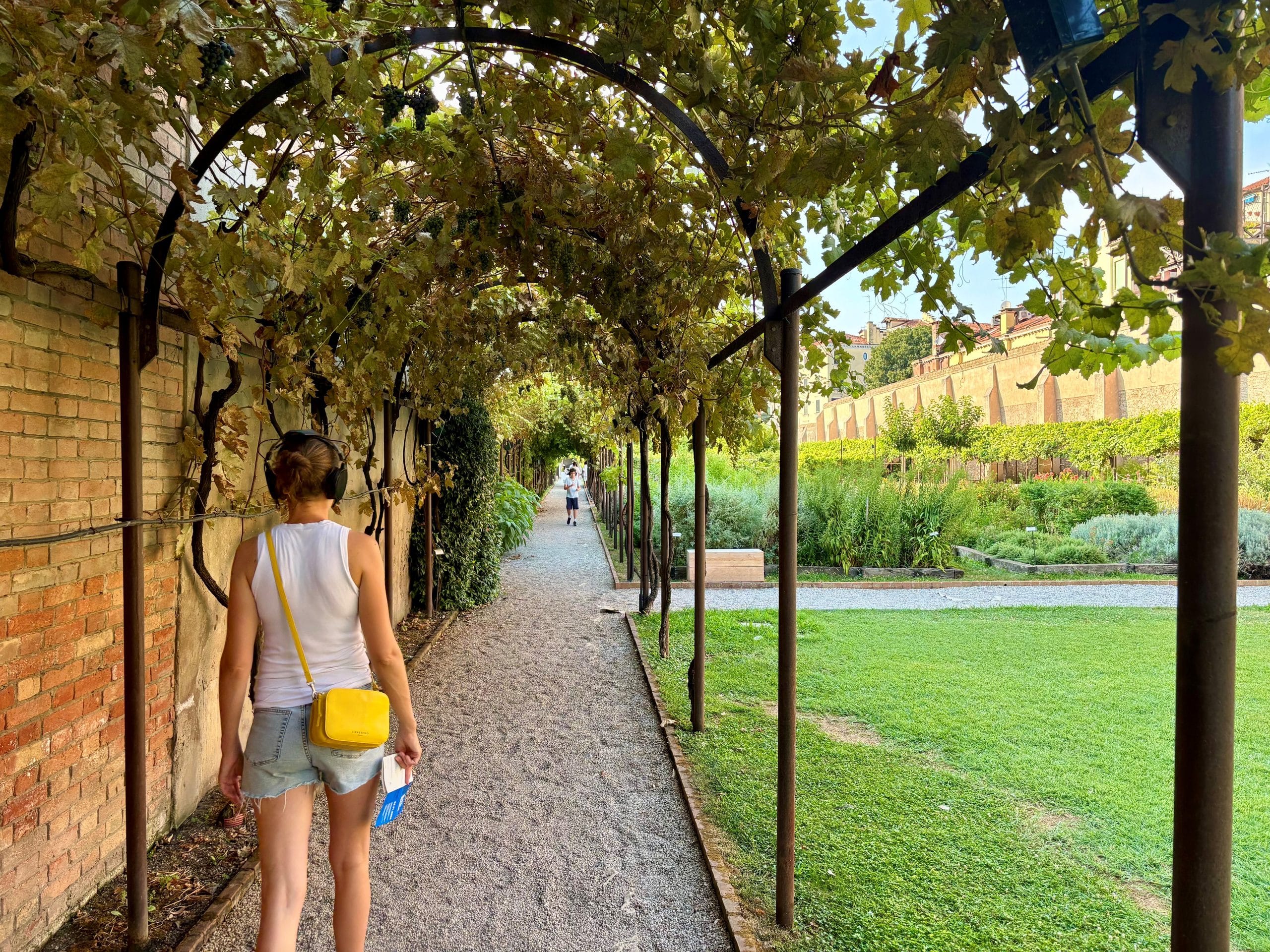
We can close our eyes to the world. Our ears remain open.
Summer brought the rest we had hoped for, an abundance of art, and a little work woven in. It also drew us back to Venice, to the places we had missed in the rush of May.
One of them was the Vatican Pavilion, curated by Hans Ulrich Obrist and Ben Vickers in collaboration with Soundwalk Collective. Its title, The Ear Is the Eye of the Soul, stayed with us and gave this essay its name. Alexander Kluge had given Obrist the phrase in his own handwriting: “The ears are the eyes of the soul.” A small final thought from the great storyteller, who died in March this year, that also evokes Hildegard of Bingen, whose belief in sound as a way of knowing runs through the pavilion.
There was no queue, no crowd. Just before closing, we were given sixty minutes in the Carmelite monks’ Giardino Mistico: a garden that felt a world away from the bustle of Venice’s railway station, though it lay right beside it.
Headphones on. And in we went.
Outside, the bustle of Venezia Santa Lucia. Inside, the hushed stillness of the garden. We walked beneath a canopy of vines, grapes hanging so low they seemed ours to pluck from the sky. Pomegranates, tomatoes, basil, rosemary, thyme. We breathed in, looked around, listened and gradually slowed.
Through our headphones came Hildegard’s chants, sung by Benedictine nuns from Eibingen, woven together with compositions made for the garden by Brian Eno, FKA twigs, Meredith Monk, Terry Riley and others. The garden became an orchestra; sound gave it a second life, and we moved within it. Works by Otobong Nkanga and Precious Okoyomon appeared almost in passing.
At the end of the path stood a small chapel in which Patti Smith’s My Name Is Mary gave voice to a mother’s love and grief. Her words shifted between prayer and lament until it was hard to tell where Smith ended and Mary began. Through the headphones, her voice seemed to come from somewhere inside our own heads. It drew us close, perhaps too close. Intensely moving, unsettling; almost intrusive. When we took off our headphones, the garden felt strangely ordinary again. We wondered how much of its magic had been ours, and how much had come through the headphones.
Never switch off.
The headphones did more than accompany our walk; they shaped what we noticed and how close each voice felt. Art no longer wants only to be looked at. It wants to be experienced. Installation, performance, immersion — another layer, another sense, another stimulus. Immersion can heighten our attention to a place. It can also make someone else’s way of listening feel like our own.
AirPods in. Noise cancelling on. The outside world off. Or is it? Another call, another podcast. Another voice message. Another song. Another audiobook. We no longer scroll only with our eyes. We scroll with our ears. And the ear has a particular intimacy. Headphones create a phenomenon known as in-head localization: a voice no longer has a visible source in front of us but seems to sit inside our own head. Experiments show that the same voice can create a greater sense of social closeness through headphones than through speakers. Perhaps that helps explain some of the success of podcasts: strangers speak for hours in the place usually occupied by our inner voice. We hardly even use noise cancelling for quiet anymore. We erase the background noise of the world so the next piece of content can reach us without interruption. The boundary between our thoughts and the voices we let in grows harder to find. News, music, messages, memories — all of it seems to sound in the same intimate space.
We listen without pause. Yet we still turn to sound in search of quiet: music to unwind, waves to fall asleep to, birdsong to soothe us. Even silence now comes with a soundtrack.
Sound as material
None of this began with headphones. More than a century ago, artists were already asking us to listen differently. In 1913, Luigi Russolo built his Intonarumori, bringing the noise of the industrial city into music. Kurt Schwitters pulled language apart in his Ursonate until words gave way to rhythm and breath. With 4′33″, John Cage asked performers to make no deliberate sound, leaving the audience to hear everything around them. Fluxus, electronic music and installation opened further possibilities. Then sampling gave artists another kind of material: sounds already in the world, ready to be recorded, cut, repeated and rearranged. A work could unfold over time, drawing us into its rhythm. We found ourselves thinking about this again in Venice.
At Fondazione Prada, Nancy Spector’s Helter Skelter brought together Arthur Jafa and Richard Prince. Both work with images already circulating through American culture, but they see a very different America in them. Prince draws on the imagery of white American myths. Jafa places Black culture at the center of the story, where its influence has been all along. The pairing was one of the highlights of our visit.
What stayed with us was the way Jafa makes images sound. He draws on film, YouTube, news and popular culture, mixing found footage with his own. He cuts and repeats, slows a sequence down or lets it rush past. In what he calls Black Visual Intonation, he brings the timing and expressive force of Black music to the moving image. A cut lands like a beat; a repeated image becomes a refrain. His work asks whether images can carry something of the beauty, power and estrangement that Black music holds within American culture. Watching, we begin to feel its rhythm in our own bodies.
Sound can reach us in a way an image cannot. An image is there before us; sound arrives from all sides. It crosses a room, catches us from behind or speaks directly into our ears. It can bring a work close enough to feel almost inside us, which makes it all the more important to ask what, and whom, we are being invited to hear.
The ear as bridge and point of entry
From Venice, our trail of sound led to Berlin Art Week. There we encountered a work by David L. Johnson: small grey cages containing devices that looked much like motion sensors. They were Mosquitos, designed to emit a high-pitched whine that young people can hear but many adults cannot. Our ability to hear high frequencies fades with age. To a passing adult, the device may be silent; to a teenager, its sound can make a place unbearable. Mosquitoes were made to drive young people away from shop entrances and public spaces. Johnson takes them out of those spaces and puts them behind bars.
The work makes an invisible boundary plain. Two people can stand beside the same park bench and hear entirely different places. One is free to linger; the other wants to leave. In Venice, sound had drawn us in, close. Here, it was being used to keep someone away. We cannot shut our ears as we shut our eyes.
Few artists have followed the consequences of that fact as closely as Lawrence Abu Hamdan. An artist and audio investigator who calls himself a “Private Ear”, he founded Earshot in 2023 to investigate sounds that images and other evidence cannot fully account for.
On 15 March 2025, hundreds of thousands of people gathered in Belgrade. For 15 minutes they stood in silence, one minute for each of the 15 people then known to have died when the canopy at Novi Sad railway station collapsed. Witnesses later recalled hearing people cough from far away. Then, just before the silence ended, the crowd suddenly parted. People moved to either side of the street as though something was coming towards them at speed. Nothing appeared in the footage. The recordings offered no clear account of what they heard.
Witnesses described a noise lasting only two or three seconds: like a jet, some said, or a herd of horses with something mechanical in it. Almost three-quarters of the written accounts said they felt it as well as heard it: in their bones and muscles. Hundreds subsequently reported headaches, pressure in their ears, nausea and disorientation. The sound left thousands of people with a memory they could describe, though the authorities denied that any such device had been used.
Earshot set out to reconstruct the event from what remained. Its investigators analyzed 19 videos, examined 3,244 written statements and conducted 15 detailed earwitness interviews. By comparing memories, locations and descriptions of the sound, they gradually built an account of what the recordings alone could not establish. Earshot concluded that a directed acoustic weapon had probably been used and examined the LRAD 450XL in particular. The Serbian authorities continue to deny its use.
In 450XL: The Story of a Fugitive Sound, shown in Canicula at the Ospedaletto, Abu Hamdan brings that investigation into the exhibition space. Across fifteen screens, drone footage of the crowd is interrupted by black-and-white intertitles carrying the earwitnesses’ words. For nineteen minutes, we read people’s descriptions of a sound while hearing almost none of it ourselves. Only one second of Earshot’s reconstructed sound enters the work; the remaining audio is a composition by James Hoff.
The restraint matters. Abu Hamdan does not ask us to relive the protesters’ fear through a dramatic reconstruction. He leaves us with their accounts and with the limits of our own hearing. What does it take to believe someone who heard what we cannot? Following the logic of silent film, the work seeks, as its description puts it, to return to the protesters the silence that was taken from them.
We began in a garden, listening to a voice so close it seemed to become our own. We end with a sound we can barely hear, carried to us by those who were there. Between the two lies a question: what reaches our ears, and what have we learned to tune out? Perhaps it is time to switch off the soundtrack for a moment. The world will not fall silent. We might finally hear someone else.
The Sound of Silence.
Marie-Kathrin Krimphoff and Carolyn Stocker-Seiler