London Calling. Paris answering.
Every October, the art world performs the same balletic leap across the English Channel: from Regent’s Park to the Grand Palais, from Mayfair to the Marais. The Eurostar becomes a rolling who’s who of the art market. The cast remains largely the same; only the scenery changes. This year, though, the choreography fell spectacularly out of step.
Since Brexit and a succession of tax contortions, London has often been written off as yesterday’s art-market capital. This autumn, it proved full of life. Paris, meanwhile, the much-admired grande dame of the market, long blessed with beauty, grandeur and a generous dose of savoir-vivre, found itself overtaken by its own political reality.
Let’s begin in London, where the stars were aligned, and not just in the art-market firmament.
London Calling: Ground Control To Major Tom.
Things turned cosmic, surreal and delightfully absurd. In Mayfair, René Magritte turned reality on its head. With This Is Still Not a Pipe: The Afterlife of Magritte, Gagosian staged an encounter between the Belgian Surrealist and more than forty artists from different generations that was as intellectually astute as it was spectacular.
Alex Da Corte translated Magritte’s enigmatic world of everyday objects into the visual language of pop culture; Victor Man conjured his dark, closed-off pictorial worlds; Glenn Ligon probed the relationship between language and image; and Issy Wood’s psychologically charged paintings tipped the familiar into the uncanny.
Ninety years after the legendary International Surrealist Exhibition of 1936, held just a few steps away, Surrealism felt fresh again.
Apples, pipes, bowler hats, clouds: Magritte’s familiar motifs continue to defy certainty. In La Lampe philosophique (1936), a nose becomes a pipe and a candle an impossible source of light. Magritte needed no artificial intelligence to conjure realities that do not exist. Long before us, he understood that images are assertions, and that words do not always deliver what they promise. In an age of AI-generated imagery, alternative truths and digitally constructed realities, his work feels like a remarkably prescient preview.
Just a few streets away, at Sadie Coles HQ on Savile Row, Nicole Eisenman delivered one of the real sensations of the season: a tour de force of cosmic wonder and political grotesquerie, executed with overwhelming force and virtuoso skill.
In the nearly seven-metre-wide The Waiter (2026), we find ourselves standing in the middle of Stonehenge, with a dizzying universe of planets, stars and distant galaxies swirling above us. Between the ancient stones and the infinite cosmos stands a waiter carrying a tray, as if he has wandered into the wrong dimension. The painting stretches from the mysteries of early human history to the farthest reaches of the universe, and there we stand in the middle of it all: astonished, lost, bewildered. Thanks to gravity, at least, we remain firmly grounded.
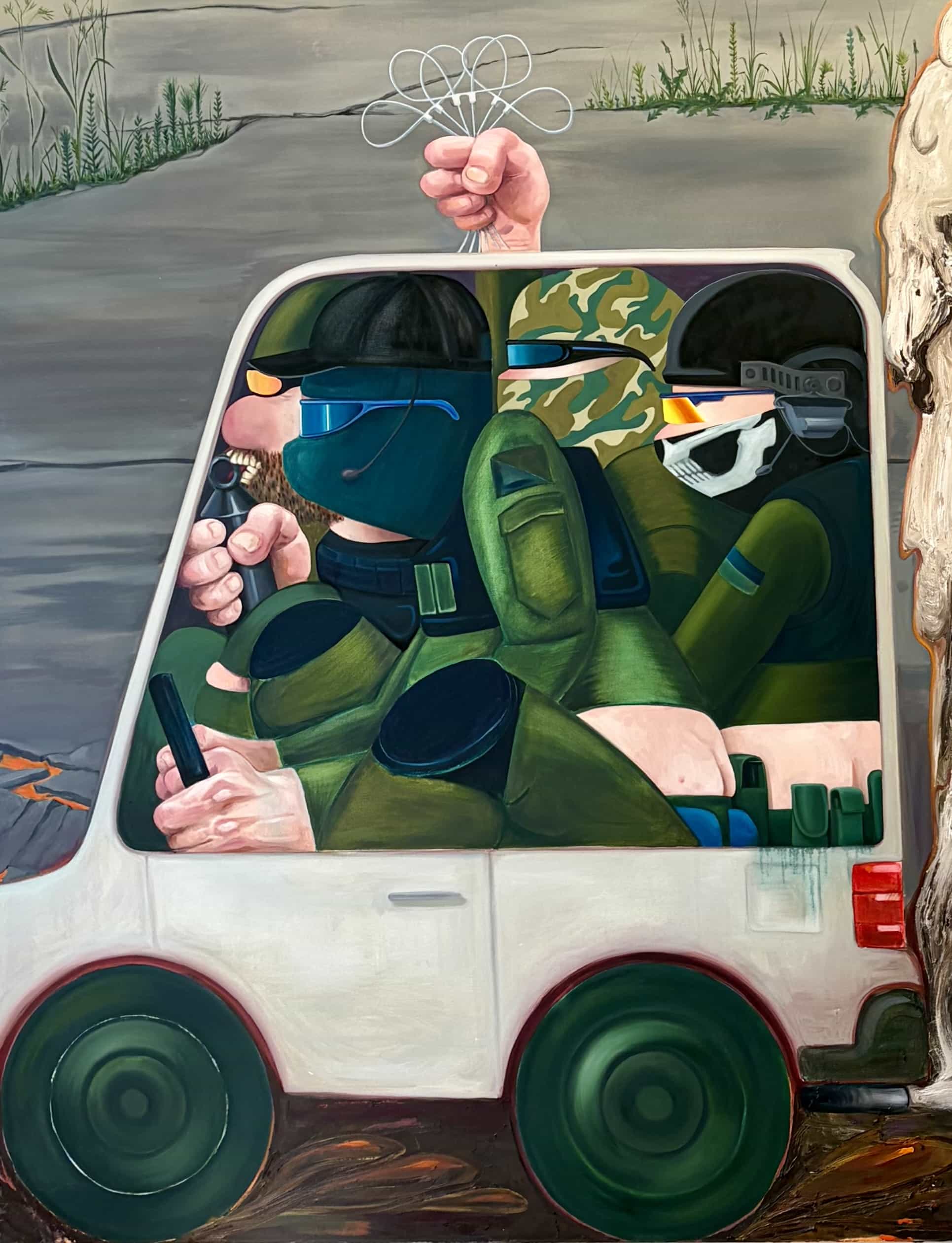
Eisenman is equally merciless when it comes to the political present. In Parking Lot of Violent Forces and Depressive Positions (2026), masked, militarised figures with fascistic overtones are crammed into a tiny vehicle. Beside them looms a monstrous, melting ICE Man, while a woman pushes her shopping trolley across a bleak, broken-up car park. The threat of militarism tips into grotesque comedy; the absurd becomes otherworldly.
Eisenman combines grand painting with wickedly dark humour, the comic with the tragic, the everyday with the apocalyptic. Her visual worlds are as fantastical as they are disturbingly familiar. The surreal is no escape from reality. It may be its most accurate description.
At Thaddaeus Ropac, Georg Baselitz’s Heroes paintings of 1965–66 offered a different kind of reckoning. The paintings were made when Baselitz was just 27, as the international art world increasingly turned towards Minimalism, Pop and Conceptual Art. Baselitz died in April, aged 88, lending the exhibition an additional note of farewell.
His monumental antiheroes resemble the ghosts of a traumatised nation. Wounded and mutilated, dressed in tattered uniforms, with oversized hands and feet, they stand forlornly in barren landscapes. These are no victors or glorious homecoming heroes, but broken figures stripped of any remaining heroic certainty. They are images of a Germany reinventing itself during the economic miracle, while the horrors of war remained far from healed.
Sixty years later, their relevance is disquieting. One cannot help thinking of Ukraine, of traumatised soldiers returning from war, and of the families and children forced to live with the consequences. As after every war, it is the human cost that outlasts the headlines. Baselitz does not show us the hero who makes history, but the human being scarred by it.
Frieze. The Reportedly Dead Live On.
In Regent’s Park, meanwhile, Frieze London and Frieze Masters returned, colourful, confident and very much alive. Some prominent galleries were missing. Almine Rech, James Cohan, Sean Kelly and Tina Kim sat this one out, as did Kurimanzutto. Stephen Friedman was absent following the gallery’s entry into administration, though some of its former artists appeared elsewhere, including Denzil Forrester at Thaddaeus Ropac.
Pilar Corrias Gallery, absent from its home fair since 2023, returned with a presentation devoted to early modern British landscape painting.
At the larger galleries, scale and colour set the tone, with several devoting their stands to a single artist. Gagosian showed six large canvases by Albert Oehlen, while Pace presented Marina Perez Simão’s studies in colour. But the clear standouts were Dalton Paula’s portraits at Lisson and Miriam Cahn’s paintings and drawings at Galerie Jocelyn Wolff.
Marc Glimcher described London as a natural home for solo presentations and Paris as the more buoyant selling opportunity.
In Focus, the section for younger galleries, the mood was less cautious. Steph Huang transformed Public Gallery’s stand into Lili Deli, a grocery shop whose wares were rendered in hand-blown glass and cast metal. Harlesden High Street sold Marcus Jefferson’s eerie reconstruction of a local newspaper office to a Dutch collector for £40,000.
At the top end of the market, the picture was more complicated. Since the 2024 tax reforms, London has faced mounting pressure. Iwan Wirth has moved his main residence back to Switzerland and told The New York Times that London was no longer the market’s centre of gravity. Welcome home!
Sales elsewhere were brisk, too. Gagosian and Frieze newcomer Alice Amati were among the galleries reporting sold-out stands within hours of opening. Gagosian sold all six Oehlen paintings for more than $1 million apiece, while Pace also reported selling its entire presentation. The highest reported sale on the first day came from Frieze Masters: a flower still life by Jan Brueghel the Elder, around four centuries old, which fetched approximately £5 million at Hauser & Wirth.
Contemporary prices were more modest, even where dealers reported strong demand.
London is also finding room for new spaces. At Interval, in an eighteenth-century Clerkenwell house, a Richard Serra print hangs opposite a fifteenth-century marble fragment. Antesala brings Latin American art to Fitzrovia. On Bedford Square, Yan Du’s YDP explored what names reveal, preserve and conceal. An Antwerp collector told The Times that he comes to London for its commercial galleries, not its museums.
Still, the museums deserved a few hours of one’s time. At the Barbican, Robert Ryman: The Real Thing brought together more than sixty works, mostly white, mostly square, never quite the same. His first major UK exhibition in more than thirty years included the rarely lent, twelve-foot Surface Veil II. At the National Portrait Gallery, Issy Wood’s self-portraits explored the neuroses of the present, with the Tudors just down the corridor. Ana Mendieta at Tate Modern, Salman Toor at the Courtauld and Edward Enninful’s The 90s at Tate Britain, were all so good it was hard finding time for the fair.
The Auction Rooms. London Wins The Week.
Paris commanded the attention on the ground, but London’s auction rooms delivered the headline numbers.
Christie’s opened Frieze Week with two evening sales on 14 October that raised £218.6 million, more than double the previous year’s total. The collection of Monsoon founder Peter Simon alone generated approximately £107.5 million, making it the most valuable single-owner collection ever sold at Christie’s in London.
The night’s top lot was Kandinsky’s Das bunte Leben (1907), which fetched £31.56 million. The painting had been restituted in 2023 to the heirs of Jewish collector Hedwig Lewenstein-Weyermann, after being lost from the family’s collection during the Nazi occupation of the Netherlands. A Mondrian followed at £25.2 million, while Liubov Popova set a new artist record at £7.6 million.
Hockney’s Dog Painting 17, a portrait of his sleeping dachshund Stanley and the first of his dog paintings to reach auction, fetched £3.5 million. Draw your own conclusions about the dachshund economy.
Sotheby’s had a more modest evening, with £46 million in sales, led by a £9.8 million de Kooning—the highest price for the artist in Europe. The house was quick to supply the wider perspective: its London sales had passed $1 billion for the year (across all categories), its strongest year-to-date since 2015.
Modern British had its own moment. Barbara Hepworth’s sculptures took the three top spots at Christie’s Modern British evening sale, with Sculpture with Color (Eos) (1946) setting a record for a unique work by the artist.
There was, of course, considerable preparation behind the applause. Established names, carefully calibrated estimates and guarantees helped reassure a nervous market. The growing reliance on guarantees is striking: nearly four-fifths of New York’s evening-sale value last year was guaranteed, up from about a third a decade earlier. Guarantees do not determine the final price, but they can secure a minimum return before the auctioneer takes the rostrum.
The recovery is real but it’s also carefully crafted.
Paris Answering. La Grandeur Et La Réalité.
Over the past few years, Paris has been pulling the autumn art calendar towards itself, as dealers and collectors increasingly skip London and head straight to the Grand Palais.
This year, the city had plenty to sustain its growing confidence. Art Basel Paris welcomed 211 galleries from 41 countries and territories, including 32 first-time participants. The wider market supplied encouraging figures, too: French art sales rose by nine per cent in 2025 to $4.5 billion, according to the Art Basel and UBS report, maintaining France’s position as the world’s fourth-largest art market. There were also a record twelve shared booths. Even in an ascendant market, apparently, it helps to split the rent.
Paris had every reason to feel confident. The city is its own best argument. Art, architecture, fashion, gastronomy: Paris needs no backdrop; Paris is the backdrop. It possesses the incomparable gift of turning even an ordinary Tuesday into a cultural event. Only this time, reality refused to follow the script.
After a weekend of mass demonstrations across France over public spending, education and the cost of living, guests arriving for Tuesday’s Avant-Première had to thread their way through concrete barriers to reach the Grand Palais. For all the unease, the art world’s major players had come to Paris anyway. Inside, conversations acknowledged the unrest before quickly returning to the more familiar question of what had sold.
Hauser & Wirth sold Gerhard Richter’s early photo-painting Rokokotisch (1965) and Georg Baselitz’s Der Hirte (1965) for approximately $10 million each. The Baselitz was, fittingly, from the Heroes series we had encountered in London just a week earlier.
White Cube placed two paintings by Julie Mehretu for $7.85 million apiece, while David Zwirner sold a new work by Marlene Dumas for $3 million. Pace Di Donna Schrader presented Modigliani’s reclining nude Nu étendu (Lolotte) (1917), which had remained in the same private collection since 1920 and carried a price tag of more than $100 million.
Some pictures are brought to fairs to find a buyer. Others justify the journey simply through the headlines they generate.
But the reality beyond the glass walls of the fair could not be kept at bay indefinitely.
Ceci N’est Pas Une Foire. Liberté Toujours!
The effects were immediate. Trips to Paris were cancelled at short notice, and not solely because of security concerns. For some, travelling to Paris to buy art seemed inappropriate
It was a remarkable response. The art world has always operated within a peculiar tension. Artists question power, inequality and political structures, yet their works are traded in a market sustained by considerable wealth. A contradiction? Certainly. But hardly a new one.
On Thursday, the political climate turned into an organisational crisis. Art Basel announced that the fair would close early, at 7 p.m. on Friday. Saturday and Sunday—two of its three public days—were cancelled. Some galleries began preparing to dismantle their stands. By Friday, Hauser & Wirth’s booth was nearly bare, its Richter and Baselitz already gone.
There were understandable safety concerns. There was also the awkward question of who had already got what they came for. The VIPs had completed their previews, the multimillion-dollar works had found new owners, and weekend ticket holders received an email.
A protest appeal circulating online had taken aim at the art world’s champagne-fuelled receptions and gala dinners while public budgets were being cut. Critics pointed out two difficulties with demonstrating at the fair on Saturday: the most important buyers would already have left, and the tickets were expensive. As it turned out, even that assessment was optimistic about access.
For galleries, the early closure was consequential. Smaller dealers depend on the public days, when collectors travel from the far and wide. The weekend tickets were to be refunded; whether exhibitors would receive compensation remained an open question.
Liberté, égalité, fraternité. Three grand words. And some rather different ideas about what they mean in the art market.
It would be too easy, however, to pit art against commerce. Artistic production, institutional patronage, galleries and collectors are deeply intertwined. Art does not emerge outside the social conditions it examines. And an art market that creates and preserves cultural value remains a market characterised by considerable inequalities.
Perhaps the real question is not whether one is allowed to buy art in turbulent times, but what responsibilities come with collecting it.
Paris. Beyond The Bubble.
Away from the fair, Paris once again demonstrated its real strength: a museum and gallery programme of wonderful density.
At the Bourse de Commerce, the Pinault Collection marked two hundred years of photography with Remember Me. Barbara Kruger transformed the Rotunda into a flurry of language, power and imagery with The History of Tears. Irving Penn was given a dedicated room for The World According to Penn, featuring around 450 photographs, from celebrated portraits and fashion images to still lifes and ethnographic studies. An exhibition within an exhibition.
No less impressive was Raymond Depardon’s series France: empty streets, deserted shopfronts and the unremarkable architecture of small French towns, photographed with a large-format camera and bathed in warm, distinctly French light. It is a quiet portrait of the country beyond the postcard clichés, finding beauty almost in passing.
The wider photographic journey brought together early masters and documentary photography to Surrealist experiments and contemporary abstraction, demonstrating just how profoundly photography has shaped our image of the world—and how far from self-evident that image really is.
Jenny Holzer turned the Musée d’Orsay into a reading room. Artists’ letters from the museum archive appeared as light projections on the façade overlooking the Seine, while text-based installations ran through the galleries. Language became image, light and public intervention.
At the Musée d’Art Moderne, Simone Fattal finally received her first Paris museum exhibition, a long-overdue recognition for an artist who has lived in the city for many years.
The galleries were no less active. Lee Krasner received her first-ever solo exhibition in France at Gagosian. Tacita Dean and Bruce Nauman explored drawing in a joint exhibition at Marian Goodman, while Jordan Casteel made her French debut at Thaddaeus Ropac’s Marais space.
And then there was Chez Sotheby’s: an apartment on Rue de Rivoli overlooking the Tuileries, hung with works by Picasso, Richter and Bacon worth approximately $150 million. There was a working restaurant, too, with cocktails by a former head bartender of the Hemingway Bar at the Ritz. The point was not simply that Paris had more to offer than its fair. It was that the city’s cultural life extended well beyond the commercial bubble beneath the glass roof.
Cloudy With A Chance of Art.
What remains after two cities, two fairs and a rather turbulent gallop through the international art world?
London, so readily written off, proved more vibrant than the obituaries would have us believe. Paris, long proclaimed the new centre of the European art market, found itself overtaken by a reality that could neither be curated nor controlled.
Perhaps the balance of power is not shifting quite as quickly as some forecasts suggest.
From Magritte’s impossible skies and Eisenman’s distant galaxies to the glass dome of the Grand Palais, this art autumn moved between surreal parallel worlds and decidedly earthly realities.
London looked to the stars.
Paris brought us back down to earth.
And Magritte? He would probably have reminded us that things are rarely what they seem.
London Calling. Paris Answering.
Or is it all about the weather?
Marie-Kathrin Krimphoff and Carolyn Stocker-Seiler