On looking, being looked at and the art of hiding
Susanna bathed. Venus slept. For centuries, Western art found occasion for looking in on women at their most private. Mythology offered cover for the voyeur, while scripture lent a certain legitimacy to indiscretion. Looking was a pleasure one could cultivate in very good company.
By the late eighteenth century, the English aristocracy had developed an ingenious form of intimate portraiture. Known as a lover’s eye, it consisted of a single eye painted in miniature, set in gold and worn close to the body. The fashion is said to have begun with the Prince of Wales, the future George IV. In 1785, he sent Maria Fitzherbert, a twice-widowed Catholic, a miniature of his own eye painted by Richard Cosway. The two married in secret shortly afterwards, despite the legal impediment to their union.
Part of the tradition’s appeal lay in the possibility of wearing a secret in plain sight. Anyone might see the eye, though very few would know whose gaze they had met. For the person who wore it, the miniature preserved something more intimate than a likeness. Even in the beloved’s absence, one could still feel looked at. There was something romantic in the arrangement, and yet something faintly unsettling: somebody is watching you.
“Men look at women. Women watch themselves being looked at,” John Berger observed in 1972. By then, VALIE EXPORT, who died in May this year, had already turned the voyeur himself into a public spectacle in Tapp- und Tastkino. Carolee Schneemann had claimed authority over the representation of her own body, and Cindy Sherman would soon take charge of the roles through which the female figure was seen.
Do Not Disturb
Sophie Calle, Tracey Emin and Issy Wood belong to three generations of artists who have made the terms of access to a private life central to their work. Calle alone has been the subject of major solo exhibitions at three European museums this year. Something Missing? which ran at the Louisiana Museum of Modern Art until September, has been followed by Matrimoni, Rotture e Funerali inclusi at MAXXI in Rome, on view until 7 February 2027, and Is It Better? which opened at Hamburger Bahnhof in Berlin on 13 November.
In February 1981, Calle took a job as a chambermaid in a Venetian hotel. For three weeks, she had access to its bedrooms during those hours of the day when guests reasonably assumed that the only thing likely to happen in their absence was that someone would make the bed.
Calle searched suitcases and coat pockets, inspected the beds, tried the guests’ cosmetics, sampled their chocolates and drank from a glass of Coca-Cola left in one of the rooms. At least, this is the account offered by her photographs and the meticulous notes that accompany them. A bedside table turned to face the wall naturally warranted closer attention. Long before Airbnb, Calle had discovered the particular appeal of checking into somebody else’s life.
One might hesitate to employ Sophie Calle as a chambermaid, yet as an artist, she is irresistible.
Much of the pleasure of The Hotel lies in the seriousness with which Calle records her indiscretions. An inventory has a reassuring air of professional purpose, even when its contents come from somebody else’s coat pocket. The documentation extends a similar courtesy to the viewer. A photograph and a few lines of text give us just enough to begin imagining the person who slept in the bed. Well before Instagram, Calle understood how much of the story an audience will supply for itself. By the time we think to question her conduct, we have already taken a considerable interest in her findings. And for all that we have learnt about the contents of these rooms, the guests remain anonymous. The person whose habits and preoccupations come most clearly into focus is Calle herself.
She exercises still greater ingenuity when the private life in question is her own. When a lover ended their relationship by email, signing off with the solicitous phrase “Take care of yourself”, Calle took him at his word. She invited 107 women to read, analyse, interpret or perform his letter. In 2007, what had begun as a private rejection became Take Care of Yourself, her contribution to the Venice Biennale. Few men can claim to have made art history by ending a relationship. Her former lover had chosen the words with which their relationship would end. Calle chose who would read them and under what circumstances. There is calculation in the gesture, though it scarcely diminishes the hurt that prompted it. Part of the work’s force lies in seeing what an artist can do with an experience over which she initially had very little say.
Breakfast in Bed
What Sophie Calle had to piece together in other people’s hotel rooms, Tracey Emin lays out for us herself.
First shown at Tate Modern earlier this year, Emin’s retrospective A Second Life is now at Louisiana, where it runs from 8 October 2026 to 18 April 2027. At its centre is My Bed (1998), one of the most intimate self-portraits in contemporary art, and one from which the artist herself is conspicuously absent. The rumpled sheets, used condoms, dirty underwear, empty bottles and cigarette ends are what remained of a period of acute emotional distress. Ordinarily, these are the things one clears away before anyone comes round but Emin invites the museum in.
From its first presentation at the Sagacho Exhibition Space in Tokyo in 1998, the bed proved a remarkably sensitive register of local attitudes. Japanese customs officials wanted it destroyed. In New York it was received as a neo-feminist statement. In London it became a national scandal. Steve McQueen won the Turner Prize in 1999, though it was Emin who dominated the public conversation.
What is striking about the reception of My Bed is how readily a judgement about the work became a judgement about the woman who made it. Critics read the contents of Emin’s bedroom as evidence of her sexual habits, her standards of hygiene and her relationship with alcohol. As late as 2011, when Brian Sewell reviewed her Hayward Gallery retrospective for the Evening Standard, the terms of his criticism were still strikingly personal.
Looking back, it is easier to recognise the assumptions behind those early reviews than to recognise our own. Where one viewer saw indecency in the unmade bed, another might see courage in Emin’s decision to exhibit it. Both readings tell us something about what we expect a woman to keep private, and what we are prepared to see once she invites us in.
Emin’s own account begins elsewhere. In a recent interview with Thomas Bärnthaler for SZ-Magazin, she compared the bed to the Shroud of Turin. The comparison is a considerable distance from the language of the early reviews, though the idea of a relic makes sense of what the work preserves. The sheets bear the physical trace of an experience she came close to losing her life to. As she told Bärnthaler, she had almost died in that bed. Declaring it a work of art had saved her.
The market had arrived at its own form of canonisation some years earlier. In July 2014, My Bed sold at Christie’s in London for just over £2.5 million, more than twice its high estimate and several times Emin’s previous auction record. She was in the saleroom to cheer the result. The buyer, German collector Christian Duerckheim, subsequently lent the work to Tate. In the space of sixteen years, the material remains of a private crisis had become a blue-chip work of contemporary art.
Emin had already put her audience’s assumptions to good use in Everyone I Have Ever Slept With 1963–1995. The title of her celebrated tent appeared to promise a sexual inventory. Inside, the names of lovers appeared alongside those of friends and family members with whom she had shared a bed. The phrase “slept with” had been perfectly accurate all along. The narrower interpretation, and whatever sense of impropriety accompanied it, belonged to us.
“Confessional art”, the category to which Emin, Nan Goldin and Sophie Calle are routinely assigned, carries a similarly revealing assumption. A confession generally presupposes that there is something to confess. In the case of these artists, what might that be? A woman’s sexuality, a failure of judgement, the ordinary circumstances of a life?
Emin challenged the premise in her conversation with Bärnthaler. She was simply describing who she was. Asked how much of her life remained private, she gave the answer that perhaps ought to have been obvious. A great deal did. She was an artist, and she chose what to show. One advantage of disclosing so much is that it rarely occurs to anyone to wonder what has been left out.
In Your Face
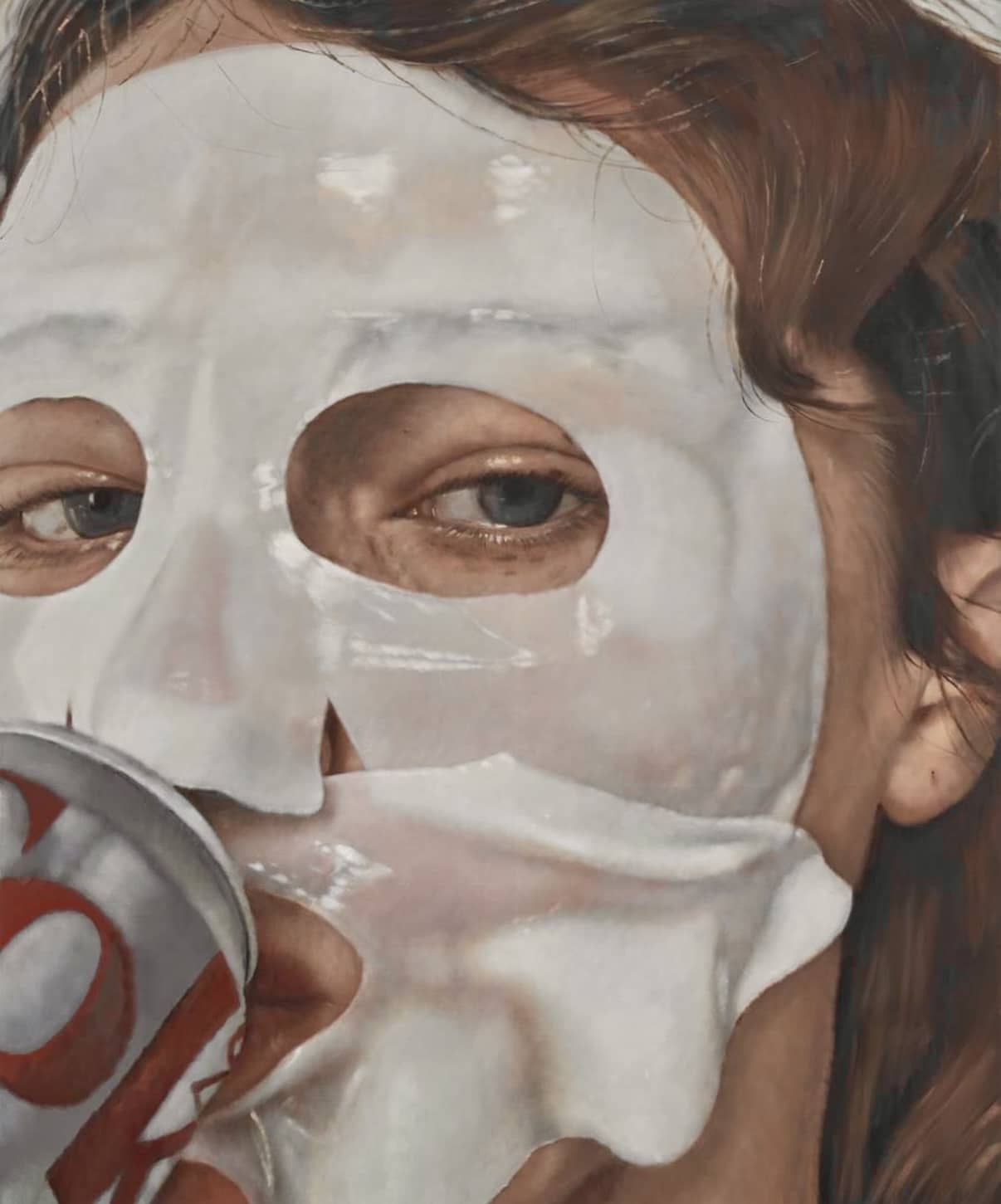
A face mask, a can of Coca-Cola and Issy Wood. The British American artist, born in 1993, dislikes having her photograph taken enough to have found a rather time-consuming way around it. What began as an attempt to avoid a magazine photo shoot developed into a series of more than eighty painted self-portraits in five years. Eleven are currently on view at the National Portrait Gallery in London, until 28 February 2027.
Wood looks as closely at a luxury car; a piece of furniture or a drink can as she does at a face or a patch of skin. Under such sustained scrutiny, familiar things begin to look peculiar. The pleasure of looking at a desirable object gradually gives way to an awareness of just how intently we have been looking.
In Self portrait 71 (2025), Wood turns that scrutiny on herself. Her face fills the frame beneath a peel-off beauty mask, a can of Coca-Cola at her lips. It is the sort of moment that would scarcely register in a day. The intimacy lies in being allowed to linger over it.
Wood has a particular gift for making light of what she has gone to considerable lengths to show us. Vulnerability takes up most of the picture, while the gesture itself appears to warrant little more than a shrug. The effect is rather like hearing someone let slip a confidence and move on before one has quite decided how to respond. Where Emin asks us to recognise the gravity of an experience, Wood seems already to have anticipated the embarrassment of being caught taking herself too seriously.
Speaking to Louisa Buck for The Art Newspaper, Wood described the strategy as “faking candour”. It is possible, she observed, to be “explosively revealing in one area” while diverting attention from aspects of one’s personality that might prove far more revealing. Exhibitionism has its uses as camouflage.
A selfie takes a matter of seconds. Wood spends days working through the painterly decisions required to preserve the impression of those seconds. The casual gesture, the awkward crop and the unflattering angle have each received her sustained attention. By the time the painting is finished, the appearance of indifference to how one looks has become a considerable undertaking.
A similar discretion governs Wood’s published diaries. We learn a great deal about her relationships, moods and emotional entanglements, while the people concerned retain the privacy of their initials. As readers, we can know quite a lot without ever entering the artist’s confidence. Calle gives herself away while observing other people. Emin produces an intimate self-portrait without appearing in it. Wood puts her face before us and leaves us to consider how far that has brought us into her life.
The Permanent Gaze
Before we have even got out of bed in the morning, we have already let half the world into it. We scroll through other people’s bedrooms, bathrooms, relationships and states of mind. We know what a stranger had for breakfast and how someone whose surname escapes us has been coping with a break-up.
Sophie Calle at least had to take a job as a chambermaid for the privilege of access.
Exhibitionism and voyeurism have enjoyed a remarkable social rehabilitation. In the vocabulary of the platforms, they have become content and engagement. Many of the visual and narrative conventions on which those platforms depend were already present in the work of Calle and Emin decades earlier. Calle understood how readily a photograph and a first-person account could persuade us to follow a story across the uncertain boundary between fact and fiction. Emin gave lasting visual form to the unvarnished and the unflattering, and to the belief that each might offer unusually direct access to a person’s experience.
For Wood’s generation, these conventions are part of the visual vocabulary of everyday life. Authenticity has a look. We recognise it in the bare face, the untidy room, the tears filmed as they fall, the selfie posted despite its conspicuously unflattering angle. What once unsettled a museum audience has become a familiar way of addressing an audience of one’s own.
Writing in 1959, the sociologist Erving Goffman understood social life in theatrical terms. There was the front stage, where we presented ourselves to others, and the backstage, where we could withdraw from view. Much of the appeal of social media lies in the access it appears to grant to that second space. Backstage has become an attraction in its own right, with the algorithm exercising a quiet editorial influence over which performances find an audience. Appearing entirely unrehearsed can, under these conditions, take quite a bit of work.
Vulnerability Is the New Luxury?
The sociologist Eva Illouz uses the term “emotional capitalism” to describe the entanglement of emotional and economic life. On social media, that relationship acquires the precision of a set of accounts. Likes, views and shares tell us exactly how much attention a disclosure has received. A confession becomes a recognisable genre. A moment of apparent loss of control can be carefully composed. The material of a personal crisis can find its way to an auction room or circulate to an audience of millions.
The tears may, of course, be quite genuine. So may the care that went into framing the shot. What has changed is the extent to which we anticipate another person’s gaze while an experience is still unfolding. Even in the moment, we can assess how it might look from the outside, and how it might be received by an audience whose members we could scarcely begin to identify. We no longer need anyone to be watching in order to feel observed. In Goffman’s theatre, at least, the curtain came down.
For Your Eyes Only
Perhaps the most elegant manoeuvre in the work of Calle, Emin and Wood is that each allows us to believe we are the ones doing the observing. We speculate about their motives, identify what we take to be their wounds and enjoy the occasional satisfaction of believing ourselves rather good judges of character.
In the course of looking, we have also disclosed a few things of our own: a taste for indiscretion, a longing for authenticity, a willingness to consume someone else’s vulnerability. And perhaps most revealingly, a tendency to assume that having been granted a glimpse, we have acquired a claim to see more. There are signs, particularly among those who grew up with social media, of a certain fatigue with the expectation of permanent public availability. Private accounts, Close Friends lists and disappearing messages all point to a renewed interest in choosing one’s audience. The instinct has a longer history than the technology might suggest.
Consider the lover’s eye again. Anyone in a drawing room in 1785 might have admired the miniature. Perhaps only one person in that room knew whose eye it was, or what it meant to wear it. Close Friends, circa 1785.
In an economy that treats visibility as a privilege, discretion begins to look like a mark of distinction. Perhaps the real luxury now is being able to choose who gets to look.
Marie-Kathrin Krimphoff and Carolyn Stocker-Seiler