There is no shortage of cultural ambition in the Gulf. Auction houses are expanding their regional footprints, fairs are recalibrating their geographies, and large-scale museums continue to be announced with striking regularity. Art Basel Qatar, with VIP access opening on 3rd and 4th February, enters as a calculated experiment with immense ambition, signaling Qatar’s intent to position itself on the global art map while testing the capacity of a new regional ecosystem.
When we looked toward the Middle East in June last year, we framed the region not as an emerging periphery but as a site of repositioning. What was taking shape then was a competition between cities and between states, many governed by royal families, actively rethinking how cultural capital, institutional presence, and market influence might be exercised outside the familiar circuits of Basel, London, and Paris. At the time, this trajectory still carried the weight of speculation. The groundwork, however, had long been in place. From Art Dubai’s launch in 2007 and the sustained curatorial authority of the Sharjah Biennial, to the opening of Jean Nouvel’s Louvre Abu Dhabi in 2017, the Gulf had already demonstrated a capacity for institutional ambition. Qatar had invested early and deeply: I. M. Pei’s Museum of Islamic Art, Mathaf: Arab Museum of Contemporary Art, and a program of exhibitions that consistently engaged with global contemporary discourse, including the landmark presentation of Etel Adnan in 2014, positioned Doha as a serious player.
Art Basel Qatar introduces a new concept, departing from the traditional booth-centric model, with Wael Shawky — an artist whose work we have followed closely since his Egyptian Pavilion in Venice in 2024 — at its helm. Shawky is collaborating with Vincenzo de Bellis, Art Basel’s Chief Artistic Officer and Global Director of Fairs, negotiating between an institutional approach and an emerging local ecosystem. The edition is structured around the thematic framework Becoming, emphasizing transformation, process, and growth. Basel positions the format as anchored in curatorial rigor and conceptual depth, privileging solo presentations, regional voices, and a dispersed exhibition model across sites including M7 and the Doha Design District in Msheireb Downtown.
More than half of the 87 exhibitions draw from the Middle East, North Africa, and South Asia, with artists such as Etel Adnan, Simone Fattal, and Ali Banisadr represented. With each gallery limited to a solo presentation across multiple sites, the fair works less like a market and more like a city-wide exhibition. The challenge will be translating these curatorial ambitions into tangible, long-term cultural and market impact. There’s talk that many works presented are spoken for by the Qataris — a clear sign of the region’s immense purchasing power but also raising questions about market transparency and the free flow of art internationally.
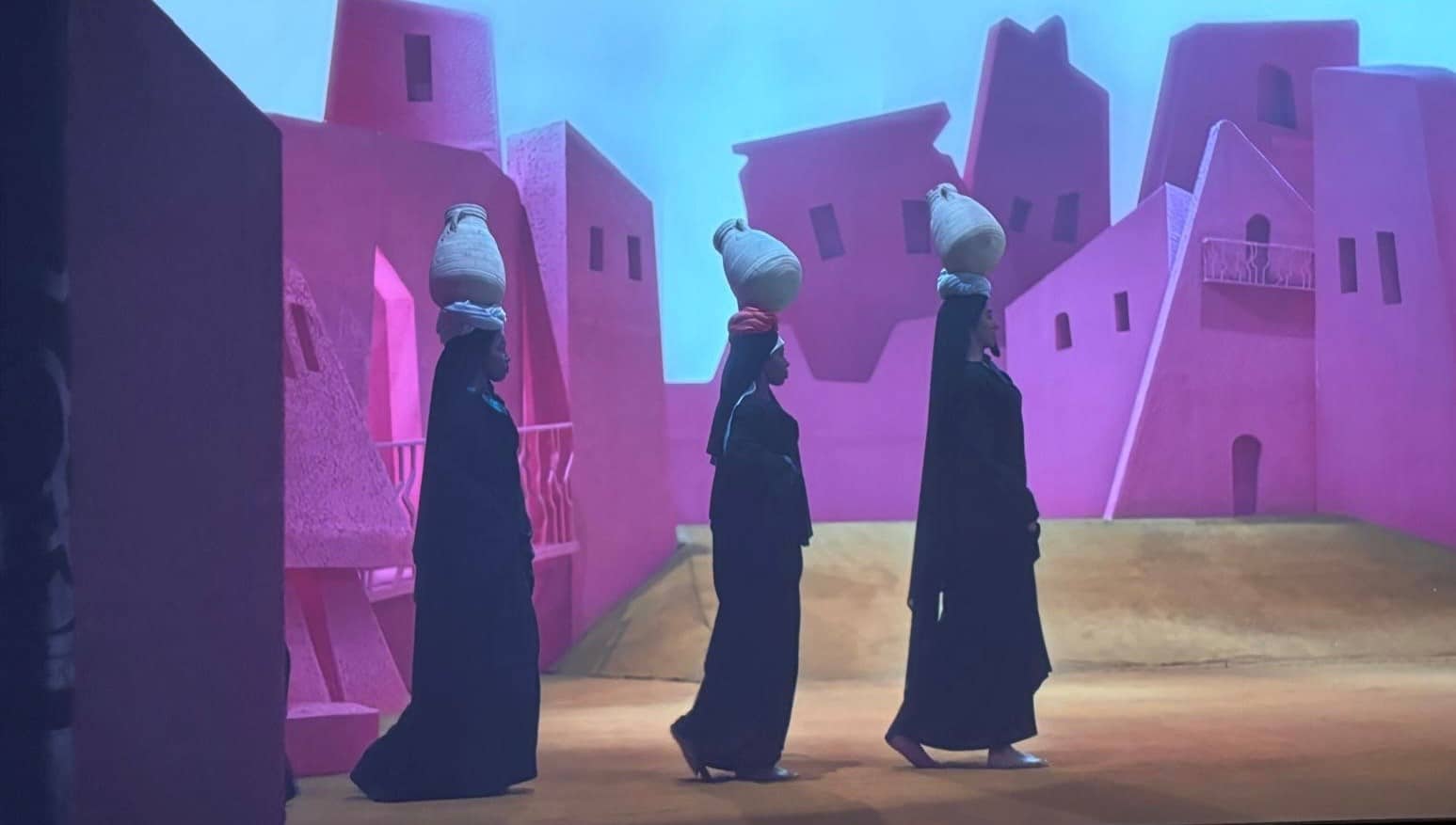
Shawky’s appointment as Artistic Director of Art Basel Qatar is part of a broader institutional alignment. His practice concerns itself with how histories are constructed, transmitted, and mediated — often through constraint, choreography, and material intelligence. These concerns were articulated in his Egyptian Pavilion at the Venice Biennale, where marionette-based narratives staged history as something performed and inherited rather than resolved. His 2016 solo exhibition at Kunsthaus Bregenz, Cabaret Crusades, staged narrative and spatial control within a calibrated architectural and temporal framework, underscoring how histories can be mediated through form, performance, and structure. Earlier this year, Shawky assumed leadership of Doha’s Fire Station Artist-in-Residence program, cementing his role within Qatar’s production infrastructure. These positions suggest an attempt to move beyond representation toward infrastructure: linking international visibility with the conditions necessary for artistic production, research, and sustained practice. Further, Qatar’s decision to establish a permanent national pavilion in the Giardini at the Venice Biennale signals a long-term commitment to placing its artists within the most established framework of global exhibition-making.
If Art Basel Qatar represents visibility and market calibration, Rubaiya Qatar operates on a different register. Rubaiya, a new quadrennial dedicated to experimental contemporary practices, showcases process-driven work across multiple sites. The inaugural edition, Unruly Waters, is centered at Al Riwaq, adjacent to I. M. Pei’s Museum of Islamic Art — a location that situates contemporary practice within one of Doha’s most symbolically charged institutional sites. Among the works included is Rirkrit Tiravanija’s Untitled 2025 (No Bread, No Ashes), a bread-baking performance foregrounding labor, participation, and collective experience. The new quadrennial is positioned to become one of the Gulf’s most closely watched contemporary events, alongside the Sharjah Biennial and newer government-backed initiatives such as Saudi Arabia’s Diriyah Contemporary Art and Islamic Arts Biennales. Qatar has historically lacked biennial-style contemporary art exhibitions, and we are curious to see how this new quadrennial shapes the country’s cultural landscape.
These ambitions unfold within a region that remains geopolitically complex. US and UK forces continue to be stationed at Al Udeid Air Base near Doha, and tensions with Iran persist, shaping international perception. While cultural programs proceed, such conditions inform how collectors, institutions, and artists assess long-term engagement. What distinguishes the current moment across the Gulf is not only scale or funding, but governance. Cultural initiatives are increasingly shaped by Western-educated members of ruling families, who have appointed international experts to senior roles and embedded global standards within new frameworks. These appointments accelerate credibility, expertise, and international integration. In Qatar, this triumvirate — Art Basel Qatar, Rubaiya, and the Venice Biennale pavilion, amongst other projects — makes the strategy clear. Together, they suggest an ambition to move beyond episodic visibility toward a lasting cultural ecosystem: one capable of supporting artistic production and critical discourse. The infrastructure is assembling with remarkable speed. What remains unresolved is whether depth can be cultivated at the same pace as attention and whether these cultural strategies will truly resonate within society and drive sustainable change.
Carolyn Stocker-Seiler