
“The world is facing tremendous upheaval. […] The irony is that people who have tried to predict doom in the wake of automation have always been wrong.”
– Robert J. Shiller, Nobel Prize winner for economics
“Technology is developing at an exponential rate. […] I think the fact that something hasn’t happened in the past is poor evidence that it won’t happen this time either.”
– Robert J. Shiller, Nobel Prize winner for economics
On the stock markets, companies and industries whose business models could be threatened by the increased use of artificial intelligence (AI) have recently been under scrutiny (“AI scare trade”). At the macroeconomic level, the question arises as to what the economic consequences of the AI revolution might be. Will it merely trigger a new, profound structural change that will ultimately improve people’s lives and replace “old” jobs with “new” and better ones? Or will the rapid spread of artificial intelligence possibly lead to mass unemployment?
The two opening quotes from Nobel Prize-winning economist Robert J. Shiller show how uncertain and ambivalent the outlook is. Shiller devoted two entire chapters to the risk of technological unemployment in his book “Narrative Economics.” In chapters 13 and 14, he impressively shows that groundbreaking technological innovations have regularly been accompanied by fears of the end of work. Narratives about impending mass unemployment had the potential to dampen the mood among citizens and consumers, thereby also weighing on the economy.
Previous technological upheavals were always accompanied by claims that this time everything would be different than ever before. The fact that previous episodes of structural change had brought progress and prosperity rather than the end of work never managed to reassure the skeptics of the day. They did not attribute the same disruptive potential to previous technological upheavals as they did to the current one. The same is true today in connection with artificial intelligence. Skeptics emphasize the risks to the labor market and society associated with the AI-induced productivity surge. They argue that the use of artificial intelligence eclipses everything that has come before.
However, historical experience suggests that the skeptics are wrong again and that the AI revolution will not lead to mass unemployment. Although jobs and possibly entire professions will fall victim to artificial intelligence, historical experience shows that new jobs and professions will be created on a similar scale. Current empirical studies also conclude that the labor market is changing as a result of the use of artificial intelligence, but that we will not run out of jobs overall (e.g., Kiel Institute, 2026).
FIGURE: AI REVOLUTION: WHAT ARE THE OVERALL ECONOMIC CONSEQUENCES?
Non-representative survey on LinkedIn
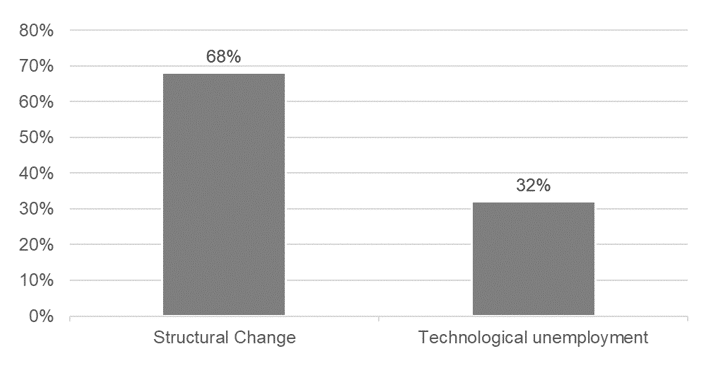
Source: Bergos.
Base scenario: Structural change
In 2015, we collaborated with the Hamburg World Economic Institute (HWWI) on a study of the digital economy, outlining macroeconomic scenarios: What consequences might the rapid increase in computer performance, combined with big data and breakthroughs in artificial intelligence, have? Our base scenario at the time was one of structural change, in which the economy and society as a whole would achieve a higher level of prosperity and the processes of change would follow familiar paths. Old jobs would be replaced by new ones, and the gains of the winners would exceed the losses of the losers. This would leave sufficient scope for redistribution to compensate the losers for their losses through social policy measures.
Risk scenario: Technological (mass) unemployment
We have also outlined a risk scenario (“20:80 society”) in which digitalization leads to more growth and prosperity, but nevertheless creates a serious problem: Due to rapid technological progress, prosperity can be produced with significantly fewer workers. The result would be technological (mass) unemployment. In this case, it would not simply be a matter of structural change, in which everyone can remain the “architect of their own fortune” as long as they are sufficiently flexible and willing to work hard. Rather, significant sections of society would be excluded from the labor market and prosperity, no matter how motivated, willing to work, and flexible they were.
What if…?
In 2015, we considered the risk scenario to be much less likely than the base scenario. Given the impressive capabilities of artificial intelligence and its numerous foreseeable applications, the probability of the risk scenario has now increased significantly. It is at least high enough that it is worth asking the “what if?” question. What would be the social, economic, and monetary policy implications if the risk scenario of mass technological unemployment were to occur?
Who would be affected? The use of artificial intelligence poses a particular threat to creative professions and “knowledge workers” (from routine to specialist tasks). Their creativity and expertise are devalued. The potential for substitution is increasing particularly sharply in expert professions, even though substitution is still highest in absolute terms among assistants and skilled workers (IAB – Institute for Employment Research, 2025). In contrast to previous upheavals, it is the more “pleasant,” well-paid professions that appear to be at risk. Job seekers would increasingly gravitate toward “AI-resistant” professions. The increasing supply of labor would put pressure on wages in these professions (which are often not very high anyway). Overall, in such a world, the economy would be less divided in terms of labor than it is today. Due to a lack of income or lower incomes, “do it yourself” is likely to come back into fashion.
Lack of adjustment mechanism. The usual labor market and social policy instruments (including promoting further training, liberalizing labor markets, and strengthening work incentives) no longer function in such a risk scenario. The demand for labor is permanently much lower than the supply of labor. There is no wage level that can balance supply and demand. Citizens want to work but cannot find jobs because their further training cannot keep pace with the speed of AI development. There is no systemic adjustment mechanism.
Distribution issue: between paradise and hell. With significantly fewer workers than today, everything that society needs can be produced. Thanks to the enormous surge in productivity, the problem of scarcity has been overcome in parts of the economy. Whereas in the past the main issue was the optimal allocation of scarce labor and scarce goods/services, the focus is now shifting to the question of distribution: How can those who are no longer needed in the labor market earn a living?
A peculiar situation could arise: AI-generated products and services are likely to be overproduced. This is fueled by a “rat race” among those who see their incomes dwindling and are desperately trying to remain marketable with the help of artificial intelligence. The high (and rising) costs are no longer in proportion to the economic returns (for the economics of rat races, see Akerlof, 1976).
Today’s “attention economy,” including hyperactivity on social networks, can be seen as a harbinger of such rat races. In some segments, there is abundance, and citizens have access to many goods and services free of charge or at low cost. What is scarce is rather the time to consume the explosively growing supply of goods and services.
On the one hand, conditions are almost like in paradise, but on the other hand, a large part of society lacks the money to buy goods that remain in short supply (food, etc.). The “winner takes it all” distribution logic already observed in the digital sector would be significantly exacerbated. In general, income and wealth inequality is increasing, partly because wages in sectors that are relatively “AI-resistant” are coming under pressure – as more and more workers whose jobs have fallen victim to artificial intelligence are flocking to these sectors. At the same time, the “AI losers” who previously earned good incomes now lack purchasing power. The distribution problem thus also becomes a problem of purchasing power and economic activity.
Social policy: The risk scenario primarily entails distribution problems. Social policy would therefore inevitably have to play a more important role. Welfare state regulations would have to be adapted to the reality of persistent technological unemployment. Active social policy aimed at getting the unemployed back to work as quickly as possible would remain justified, because even in the risk scenario, workers would still be needed in sectors that are hardly affected by the AI revolution. However, there would be an imbalance, as there are more job seekers than vacancies.
In terms of social policy, wage replacement benefits are therefore necessary for those who are permanently unable to find work. In addition, in an economy that is more strongly characterized than before by “the winner takes all” or “the winner takes most,” the purchasing power theory is likely to become relevant. Consumer demand could decline if inequality continues to increase. In previous episodes of structural change, which were accompanied by fears of mass unemployment, proposals reminiscent of the universal basic income regularly made the rounds (see Shiller, 2019).
The socio-political utopia of an universal basic income is not only unsuitable for the economic conditions we have had to date, but would even be harmful. In the risk scenario outlined, however, such a basic income could play an important role because it would not only provide basic security but also strengthen mass purchasing power. In any case, different socio-political approaches than those taken to date would be necessary.
Economic policy: What would not change is the fact that social policy measures must be financially viable. A strong economic foundation is therefore a prerequisite for the social and distributional policy measures necessary in this risk scenario. In principle, the tax base would remain high because GDP would not fall (despite sharply rising unemployment) thanks to productivity gains. Nevertheless, the tax system would have to be restructured. In the future, taxation would have to focus more on (internationally mobile) capital and companies because the tax base for labor would be eroded. Whether the welfare state remains viable therefore depends largely on whether internationally successful technology companies are located in the country in question. This would add another important facet to location competition, because attracting such future-oriented technology companies would be much more important than in the past.
Monetary policy: Developments in the risk scenario could also have consequences for monetary policy. Kevin Warsh, who has been nominated to chair the US Federal Reserve, has already pointed to the productivity-enhancing effects of artificial intelligence, which he believes will have a dampening effect on prices and thus enable a more accommodative monetary policy.
Another mechanism is conceivable, but to my knowledge it has not yet been seriously discussed in central bank circles (although Fed Governor Stephen Miran may be thinking along these lines): for many American tech entrepreneurs, the risk scenario discussed in this article is not a risk scenario at all, but their main scenario. They expect extensive job losses. This is probably why many tech entrepreneurs have long been advocating for a universal basic income. Elon Musk also recently claimed that no one needs to save for retirement anymore, as there will be an abundance of resources in 10 to 20 years. Such ideas could lead to the belief that loose monetary policy could accelerate development and bring significant advantages in international competition. After all, speed is crucial when it comes to market share in the field of artificial intelligence. Against this backdrop, the inflation risks associated with overly loose monetary policy would be negligible, as much greater profits await in the end.
Outlook
Predictions for the outcome of the AI revolution range from paradise to dystopia to largely business as usual. In other words, the outcome remains very much open. It is foreseeable that many professions—including well-paid ones—will disappear. The destructive power of artificial intelligence is therefore very easy to imagine. On the other hand, it is more difficult to imagine what new jobs will be created – because we simply do not know them yet.
With such uncertain prospects for the economy and society, it is important for politicians to be well prepared for the future. Even if the risk scenario is not yet the most likely, politicians would be well advised to have alternative economic policy concepts at the ready.
Literature
Akerlof, George (1976), The Economics of Caste and of the Rat Race and Other Woeful Tales.
Berenberg/HWWI (2015), Strategie 2030 – Digitalökonomie.
IAB – Institute for Employment Research (2025), Vor allem Hochqualifizierte bekommen die Digitalisierung verstärkt zu spüren, IAB-Kurzbericht 5/2025.
Kiel Institute (2026), Who is afraid of AI? Who should be?, Kiel Policy Brief No. 198, January 2026.
Quitzau, Jörn (2024), Künstliche Intelligenz und digitaler Umbruch – Fluch oder Segen für die Wirtschaft?, in: Rupprecht, Manuel (Hrsg.), Wirtschaftliche Zeitenwende?
Shiller, Robert J. (2019), narrative economics – How Stories Go Viral & Drive Major Economic Events, Princeton University Press.