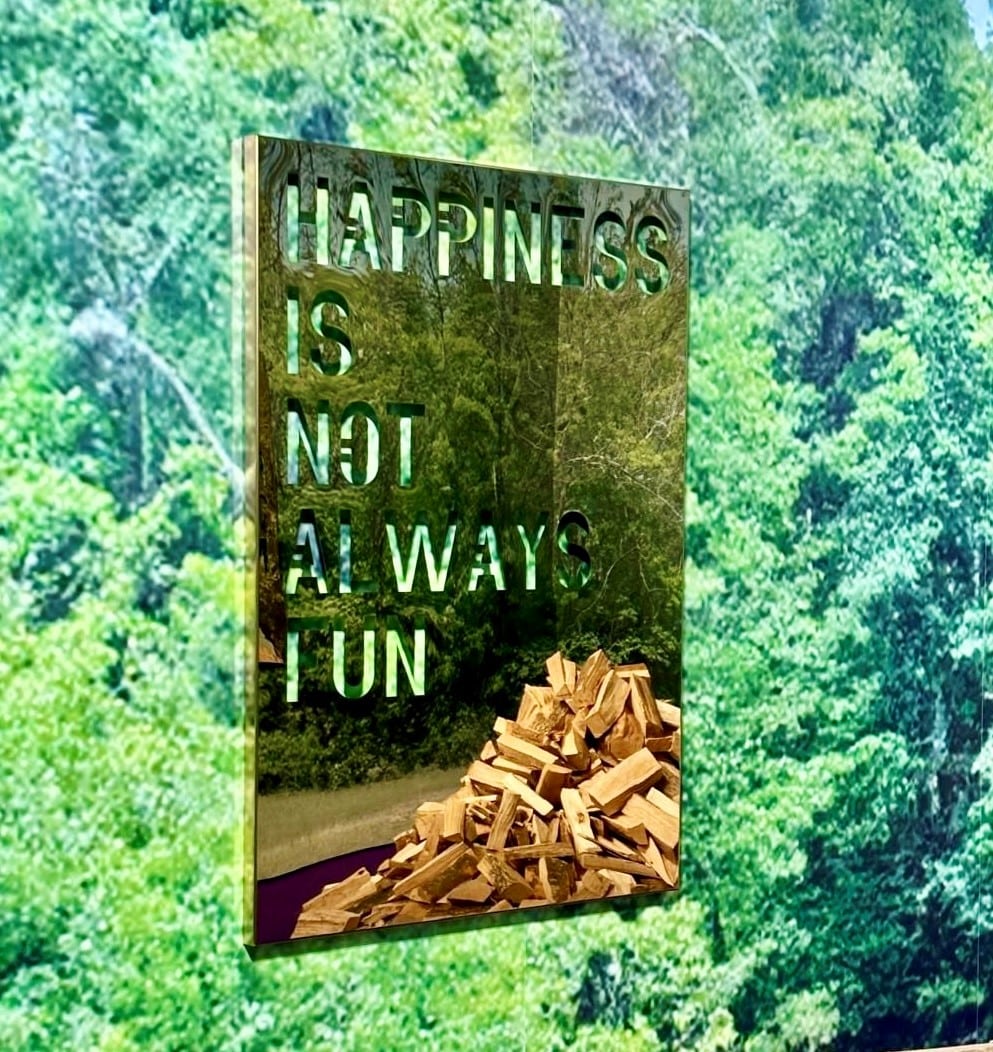
In Minor Keys does not arrive with a thesis or a statement: it tunes in. A frequency, or more precisely: an attitude of listening. One that does not presuppose attention, but demands it.
The minor key appears here not as a reduced form, but as its own logic — a different way of ordering the world. What Western ears tend to read as melancholy carries, elsewhere, beauty, celebration, the full spectrum of feeling. What it refuses is the bombast of the major key: the orchestral swell, the march, the grand gesture. Instead, a listening that does not exhaust itself in the ear.
Two years ago, the Biennale opened its theme with Schubert and a wide-ranging argument about diaspora, exile and the Global South. Adriano Pedrosa’s Foreigners Everywhere spoke loudly, decisively, at scale. In Minor Keys sets off differently — quieter, but no less determined. Perhaps this is not a response, but a shift: towards the question of what this “everywhere” actually feels like.
The curatorial concept originates with Koyo Kouoh — the Swiss-Cameroonian founder of RAW Material Company in Dakar and former director of Zeitz MOCAA in Cape Town, who passed away in May 2025 before she could realize the exhibition. Her premise is demanding: that beneath the noise of the present, something persists — and that art has the task of attuning itself to that, rather than amplifying the din.
This is more than a shift; it is a reorientation. Where Pedrosa bound art to arguments, In Minor Keys lets it be itself: sensory, affective, rooted in the everyday. Where Foreigners Everywhere named a condition of the world and called for a response, this exhibition proposes a way of inhabiting it. Not as a program but as a practice.
Within the context of what came before, this change of register is telling. Cecilia Alemani’s The Milk of Dreams (2022) and the 2024 edition were canon revisions: the rediscovery of overlooked artists, outsider voices, indigenous perspectives, the historically excluded. Necessary — and, towards the end, visibly exhausted. In Minor Keys does not contradict this; it shifts the frequency.
The literary reference points — James Baldwin, Toni Morrison, Édouard Glissant — set the tone. The exhibition is being realized by the team Kouoh assembled before her death.
Wolff Architects structure the space with indigo-colored banners; circulating through it is the principle of the Japanese komorebi 木漏れ日 — the light that falls filtered through leaves, not directly visible, but appearing in fragments, in the spaces between.
That the Golden Lion for Lifetime Achievement will not be awarded this edition, because Kouoh was no longer able to determine the recipient, is more than an organizational decision. It is an absence. And perhaps a final, quiet note.
The Main Exhibition
One of the more illuminating decisions of In Minor Keys lies in its demographic structure: over ninety percent of the 111 invited positions are living artists. While recent editions worked strongly in retrospect, the gaze here turns sideways into the present — towards practices that have not yet fully translated into global circuits, let alone established themselves within them.
Above all: mid-career artists with clear local groundings, whose legibility has not been produced first and foremost by the Western market. What emerges is a fabric, a minor-key tonality.
The structure follows seven thematic strands, among them Procession–Invocation, The Creole Garden and The Shrines. Established names such as Nick Cave, Alfredo Jaar, Laurie Anderson and Kader Attia appear alongside positions for whom this Biennale represents a first major international visibility. The mix initially seems eclectic, but it composes a picture of the present that does not think from the center outward, but from edges, transitions and displacements.
A Walk Through the Giardini
The Swiss Pavilion is one of the few contributions whose form already makes an argument: for the first time, its presentation was determined through an open call from 140 proposals. The Unfinished Business of Living Together by Nina Wakeford, Miriam Laura Leonardi, Lithic Alliance and Yul Tomatala takes as its starting point a 1978 episode of Telearena — the television format in which homosexuality was still debated as a social “problem” before a live audience.
The archive appears here not as a secured repository, but as restless material in which norms, attributions and exclusions continue to live. What matters is less the historical reminiscence than the question of what becomes audible again in returning to this material: who speaks, who is addressed, who is considered capable of speech at all.
The German Pavilion stands under different conditions. What began as a precisely conceived double presentation was abruptly altered by the death of Henrike Naumann in February 2026. She died unexpectedly two weeks before the works were due to be transported to Venice; her team is now realizing the exhibition according to the instructions she left behind.
Together with Sung Tieu, Naumann was to open a new chapter for the pavilion — moving away from national attribution, towards a closer reading of biographical and historical ruptures. Both positions share an interest in the less visible structures of history: in ideologies that inscribe themselves into everyday forms, in violence that does not appear spectacular but sediments.
Lubaina Himid in the British Pavilion is — and the word must be said — long overdue. As a central figure of the Black British Art Movement, she brings to the neoclassical building in the Giardini a visually powerful, historically dense practice with Predicting History: Testing Translation. Her works are well suited not merely to occupy this architectural inheritance but to complicate it. That the British Council took this long to arrive at the decision says as much about the institution as it does about the artist.
The United States presents Alma Allen, a sculptor born in Utah and living in Mexico. His selection follows administrative obstacles and cultural policy directives. Allen is an unusual choice for a pavilion that has recently shown strongly institutionally established names.
Yet something else is legible: an administration that wishes to assert cultural dominance presents an artist whose slow, haptic practice reads like a quiet counter-proposal to spectacle.
Florentina Holzinger develops for Austria with Seaworld Venice a setting between underwater world, sewage treatment plant and sacred space. The pavilion is not merely occupied but worked upon — turned into a processing facility: a system that expels and reintroduces, that promises purity while simultaneously exposing it as fiction.
It has been through the wash, in every sense of the word. That this will become spectacle seems likely. That it will remain clean rather less so.
Qatar enters with a deferral: the planned permanent pavilion remains for now a project; in its place, a temporary structure — prominently positioned, unmissable. At its center is Rirkrit Tiravanija, whose practice becomes the method here: assembly over object, hospitality as form.
With Sophia Al-Maria, Tarek Atoui, Alia Farid and Fadi Kattan, a socially orchestrated setting emerges from film, sound, sculpture and food. One arrives, eats, listens, stays. A contribution that exhibits less than it organizes — and formulates its ambition precisely in that.
Further into the Arsenale
The Arsenale makes clearest who understands participation not as gesture, but as stance. Morocco’s debut, Asǝṭṭa by Amina Agueznay, is an expansive installation of woven structures and organic materials, developed in collaboration with craftspeople from various regions. The concern is not reference, but practice: knowledge, technique and collective labor. In the pavilion for applied arts, Gala Porras-Kim shifts the focus from object to system. Her collaboration with the Victoria and Albert Museum interrogates museological classifications and logics of ownership. Not the artefact stands at the center, but the order that renders it visible. Most striking, however, is an absence. The South African Pavilion is officially present — and remains empty. The planned work Elegy by Gabrielle Goliath was halted at short notice after a new section addressed violence against women in Gaza. Elegy is instead on view at the Chiesa di Sant’Antonin. The pavilion remains empty. Rarely has a contribution been so present through its absence.
Satellite Exhibitions
Beyond the main exhibition, a closer look is warranted. The off-site programs are a precise complement to In Minor Keys — perhaps a shade closer to the major key.
At Fondazione Prada, Nancy Spector brings Arthur Jafa and Richard Prince together. Jafa condenses found and original material into an intense visual language that negotiates Black experience between violence and beauty. Prince, by contrast, minimally displaces existing images, raising questions of authorship and circulation. The friction arises precisely there. At Punta della Dogana, Lorna Simpson and Paulo Nazareth encounter one another. Simpson’s works remain controlled and fragmentary, while Nazareth makes movement itself a practice. Two approaches that need not converge to be precise. At the Museo Correr, Julian Charrière brings Antonio Canova into dialogue with the present. Spiral Economy reads classicism against contemporaneity. Marble appears here not only as form but as resource. At SMAC, Lee Ufan is honored on the occasion of his 90th birthday. Stone, metal, space — a practice of reduction that feels singular in this context. The Holy See offers a different kind of reduction. In the enclosed monastery garden of the Carmelitani Scalzi, the Soundwalk Collective creates an acoustic space conceived as a place of prayer. Sound instead of image, duration instead of event. Under the guiding motif “The ear is the eye of the soul,” listening is elevated here to a stance — as a quiet, insistent gesture. Palazzo Grimani presents Amoako Boafo with a clear painterly position. His finger-painted portraits of Black figures are direct and corporeally present. And Shirin Neshat continues her filmic work at Palazzo Marin with Do U Dare! — a young Iranian woman in New York, between self-invention and estrangement. It is these works that carry the satellite program. Less gesture, more focus. Less minor, more melody.
In Minor Keys is not a Biennale that settles on a single tone. It unfolds as polyphony, as the layering of different voices, tempos and intensities. Not everything coheres; some things remain dissonant; others are surprisingly clear. Its strength lies precisely there. What emerges is not a harmonious whole, but a shifting sound-image that continually reorganizes itself. Perhaps this is exactly what this Biennale proposes. Not a unified tone, but a state between minor and major. Not a choir, but an ensemble. And a listening that does not seek resolution but holds the multiplicity of voices.
Carolyn Stocker-Seiler und Marie-Kathrin Krimphoff