There are moments when the art world’s various registers — institutional, commercial, curatorial, geopolitical — speak across one another with unusual clarity.
The seventh edition of Frieze Los Angeles opened a week ahead of March, from February 26 to March 1 at the Santa Monica Airport, where sales were notably strong from the outset. In the Focus section, curated by Essence Harden, Sea View’s solo presentation of Zenobia Lee sold out during the VIP preview, with one sculpture acquired by the California African American Museum and another through the MAC3 collaboration between the Hammer, LACMA, and MOCA. The signal from Los Angeles was warmer than it has been in some time, extending to the fair’s new ownership. Ari Emanuel, chief executive of Mari Group, which acquired Frieze last year, walked into the Fort Gansevoort stand during the opening hours and purchased three figurative quilts by 87-year-old Yvonne Wells.
The 82nd Whitney Biennial, curated by Marcela Guerrero and Drew Sawyer, opened on March 8 as the longest-running survey of contemporary American art. This year’s edition is deliberately open-ended, assembled around what the institution describes as a constellation of feelings: angst, tenderness, amusement, and unease. The exhibition is structured to foreground texture and atmosphere, rather than argument. In the current political climate, prioritizing atmosphere over position reads as remarkably cautious. The return to material thinking — textiles, ceramics, fiber-based practices — reflects broader resistance to algorithmic flatness, and the Whitney gives this tendency institutional weight, though the question remains whether weight alone is enough.
Recent Whitney editions have served as a seismograph for American artistic practice. Those conditions have shifted materially. Funding is under pressure, cultural institutions face political scrutiny, and even long-established organizations now operate under markedly different constraints. Against this backdrop, the 2026 Biennial feels notably reticent. The 56 artists, duos, and collectives reflect less a political diagnosis than diffuse emotional registers — an exhibition that gestures toward the zeitgeist without quite grasping it.
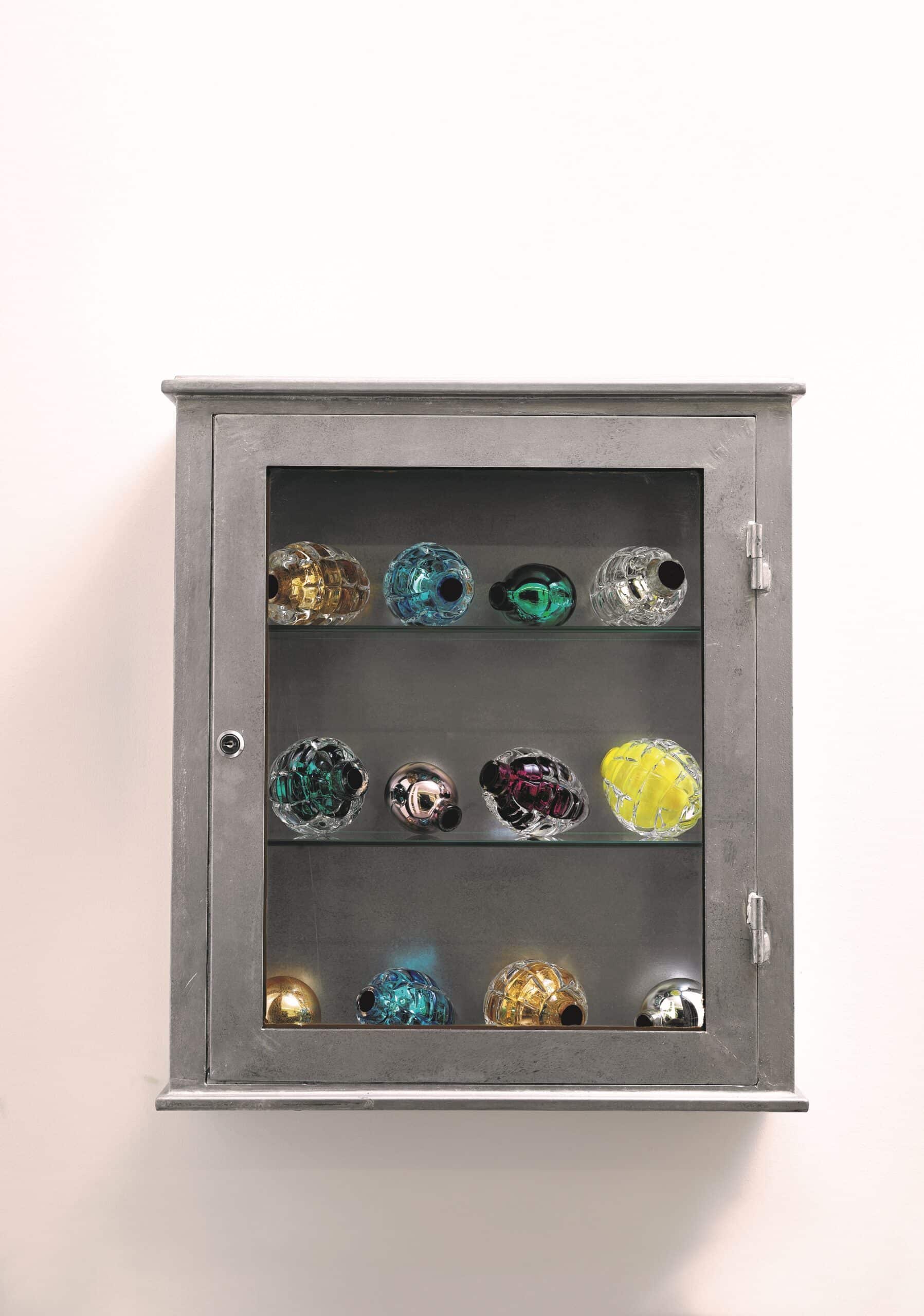
Individual works nonetheless make their mark. Raven Halfmoon’s nine-foot ceramic figures assert space for Caddo Nation women through sheer presence. Kelly Akashi reconstructs her chimney, the sole remnant of her home after the Altadena fires, in cast glass bricks, translating private catastrophe into quiet, insistent material inquiry.
Aziz Hazara, based in Berlin and barred from entering the US because of his Afghan citizenship, photographs landscapes through night-vision goggles discarded by US and NATO forces, then sends the work to a museum he cannot enter, the contradiction at the heart of the piece. That the curators chose not to frame these works within a stronger political argument might initially seem open to interpretation. In practice, it reads as strategic caution. At a moment when political conflict reaches into cultural institutions, the retreat from clearer positioning feels deliberate.
While New York debated moods, London’s market spoke a more unambiguous language. Sotheby’s opened on March 4 with what its head of Modern and Contemporary Art Europe called the first various-owner white-glove sale in his 22 years at the house. All 54 lots sold, totaling £131 million — more than double last year’s equivalent. Christie’s evening sales followed at £197 million, up 52 percent year on year. Blue-chip works with indisputable provenance and strong institutional backing are finding buyers. A similar picture emerged at TEFAF in Maastricht, where museum-quality work continues to meet stable demand. The message from these weeks is clear: blue-chip works continue to find buyers. Beyond that segment, however, the market remains more fluid, with flexible valuations and growing room for negotiation.
Clare McAndrew’s UBS Art Market Report for 2025 confirms this. Global art sales grew four percent to an estimated $59.6 billion, ending two years of contraction. Public auction sales rose nine percent, while the dealer sector recorded just two percent growth. The closures of 2025 tell the same story: Blum, Venus Over Manhattan, Clearing, and Kasmin; Perrotin and Pace retreating from Hong Kong; Stephen Friedman shuttering his New York space.
Art Basel Hong Kong opened on March 25, introducing Echoes, a sector dedicated to work made in the past five years and a counterpoint to the secondary market’s focus on established names. Encounters also steps into a new chapter, curated for the first time by an Asia-based collective led by Mami Kataoka of the Mori Art Museum, offering a genuinely regional perspective.
Curatorial presence is generating conversation elsewhere. Sam Bardaouil and Till Fellrath, directors of Hamburger Bahnhof in Berlin and curators of the Taipei Biennial, launched a new gala in mid-March for the museum’s 30th anniversary, combining fundraising, prize-giving, and social event. Mona Hatoum received a lifetime achievement award; collector Kiran Nadar was recognized for her international engagement; and three younger artists working in Germany received emerging prizes.
The day before, the Biennale of Sydney opened under the direction of Hoor Al Qasimi, whose work increasingly connects the Gulf’s cultural infrastructure with the Pacific context. Which brings us to the question hanging over all these events. In January, we described Qatar’s cultural ambitions, Art Basel Qatar, the Rubaiya quadrennial, a permanent Venice pavilion, as part of a coherent strategy: away from episodic visibility, toward a lasting cultural ecosystem. Just five weeks after much of the international art world descended on Doha, the region was at war. Art Dubai’s 20th edition, originally scheduled for April, has been postponed to May 14–17 and will adopt a stripped-back format, following flight disruptions and gallery withdrawals tied to the regional conflict. The inaugural Frieze Abu Dhabi, set for November, is continuing its preparations. Whether the Gulf’s decade-long cultural project can survive sustained conflict now presents itself with new urgency.
Meanwhile, the market consolidates, at least where capital and established value converge. High-end sales remain stable; digital platforms continue to expand. On the other side, artistic practice remains undecided, often tentative, at times almost detached. A condition emerges difficult to pin down: neither clearly political nor formally resolved, hovering between response and retreat. The same moment reveals itself as a field of tension. Market confidence gathers around what is already legible, while art resists easy grasp, as though it wants to register the urgency of the present without fully articulating it. The question of where the loud, position-taking artistic gesture has gone is increasingly pressing. Whether Venice will provide an answer remains open.
Marie-Kathrin Krimphoff & Carolyn Stocker-Seiler