Last month, we examined how geopolitical positioning shapes market infrastructure through the lens of Art Basel’s Doha expansion. Today, we turn to what collectors are acquiring, and why the answer signals something more consequential than cyclical taste.
That the past eighteen months have produced a narrower, more selective art market is hardly controversial. Auction totals have stabilized rather than surged; blue-chip works are meeting estimates rather than doubling them; private sales increasingly absorb what evening auctions cannot place.
While revenue growth was reported toward the end of 2025, it was driven less by broad-based collector confidence than by luxury categories, strategic guarantees, and private transactions. What has re-emerged instead is a preference for quality at considered price points, most clearly in the mid-market, where works have maintained consistent velocity despite broader uncertainty.
This moment is shaped by two converging pressures: global instability, which has eroded long-standing frameworks of meaning, and the saturation of algorithmically generated images, rendering visual novelty effectively infinite. Together, they have flattened experience. Speed and reproducibility increasingly outweigh depth, material intelligence, and human intention. Against this backdrop, textiles, ceramics, and fiber-based practices, long peripheral to the blue-chip canon, have moved decisively into institutional and market focus.
Major exhibitions mark this shift: Tate Modern’s Anni Albers survey (2018-9); Centre Pompidou’s retrospective of Sheila Hicks that same year; Cecilia Vicuña’s Turbine Hall commission (2022-3); El Anatsui’s metal tapestries (2023-4); the Barbican’s Unravel (2024); and Woven Histories, originating at LACMA (2023-4) and concluding at MoMA (2025), which positioned weaving not as heritage but as categorical insistence.
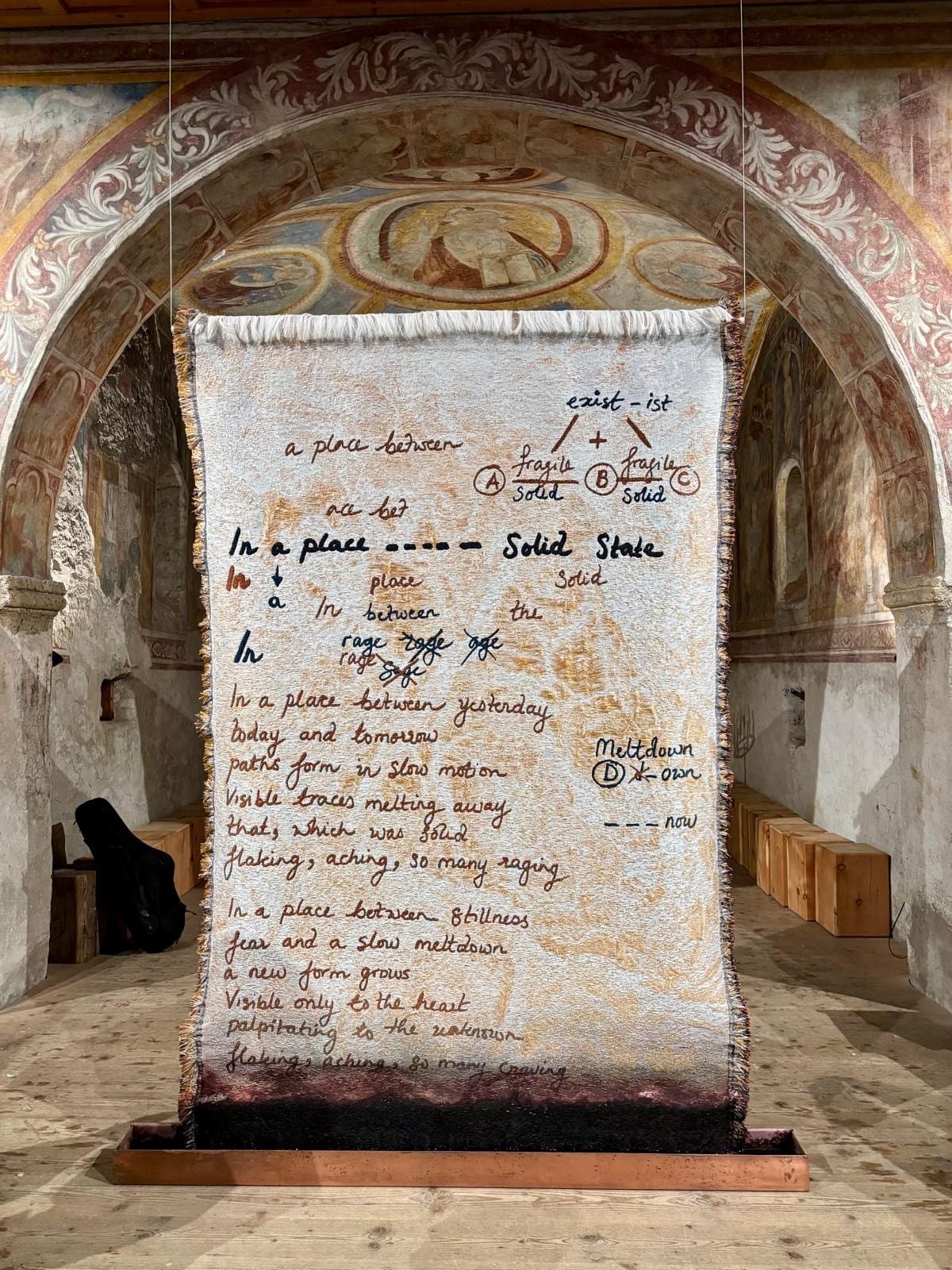
Within this landscape, Otobong Nkanga exemplifies the convergence of making and meaning. Her practice collapses making into inquiry, rendering soil, living matter, and textiles inseparable from extraction, care, and memory. Projects such as MoMA’s Cadence (2024–25) and her major survey, hosted by the Musée d’Art Moderne, Paris and on view at MCBA Lausanne from April to August 2026, show political and ecological stakes made materially legible.
Market data now reflects this shift. ArtTactic’s 2023 report documented the migration of textile works from specialist sales into marquee contemporary lots at Sotheby’s, Christie’s, and Phillips. The fair circuit remains more conservative, Art Basel’s flagship editions still privilege painting and sculpture, but secondary platforms, including Mexico City’s art week, have proven more responsive.
Venice will test how seriously institutions intend this recalibration. The 2024 Biennale under Adriano Pedrosa awarded its Golden Lion to the Māori collective Mataaho for Takapau, a monumental woven installation invoking birth and lineage. Koyo Kouoh’s In Minor Keys, proceeding posthumously under La Biennale’s leadership, foregrounds fiber and textile practices as structural rather than decorative. National pavilions reinforce the point: Dana Awartani (Saudi Arabia), Nilbar Güreş (Turkey), Faiza Butt (Pakistan), Isabel Nolan (Ireland), and Yto Barrada (France) all place textile and fabric-based work at the conceptual core of their presentations.
This re-evaluation of the textile, however, is not a phenomenon of the present. As early as the second half of the twentieth century, women artists began to assert what was supposedly marginal as a structural practice. At the Bauhaus, Anni Albers developed a distinctive approach to weaving that fused structure with the tactile qualities of the medium. She demonstrated how labor-intensive processes could produce sophisticated abstraction, positioning weaving as both intellectual and material practice. This rigor resonates today, from Nkanga’s soil- and textile-based projects to the narrative and affective intensity of Louise Bourgeois and Cosima von Bonin.
Rosemarie Trockel’s knit paintings of the 1980s, mechanically produced wool surfaces bearing logos, patterns, and signs, were never nostalgic gestures toward craft. They exposed the mechanical logic embedded within textile production itself, staging authorship as already compromised by industry, repetition, and design. In doing so, Trockel mapped the fault lines between art and craft, art and design, without the easy irony that later characterized these debates.
The question these developments pose is whether this is recalibration or reorientation. If the current appetite for materially rigorous, labor-intensive work is merely aesthetic, it will cycle. If it is structural, responding to algorithmic flattening, geopolitical instability, and a reckoning with who and what the canon excluded, then it marks a durable shift.
Seen this way, the return to material can be considered a reactivation, recalling a constructivist logic in which structure carried thought: the grid, the warp and weft, the repeated unit. What returns is the sense that structure, once embedded in matter, can think, endure, and resist in ways algorithmic production cannot.
Carolyn Stocker-Seiler